Pillow Case
17th century (made)
| Artist/Maker | |
| Place of origin |
Object Type
In the 17th century the fabric used for making into pillow cases and sheets was woven from flax or hemp. Flax made the best quality linen. Such linen, which was sometimes described as 'holland', or 'cambric', after the town of Cambrai, France, one of the original centres of production, was imported from The Netherlands, Flanders (now Belgium) and northern France. Most people would have had bed linen made from locally-grown, spun and bleached flax or hemp, however. Different parts of the plants produced fibres of differing quality, giving a range of sheeting from fine to very coarse and rough.
Materials & Making
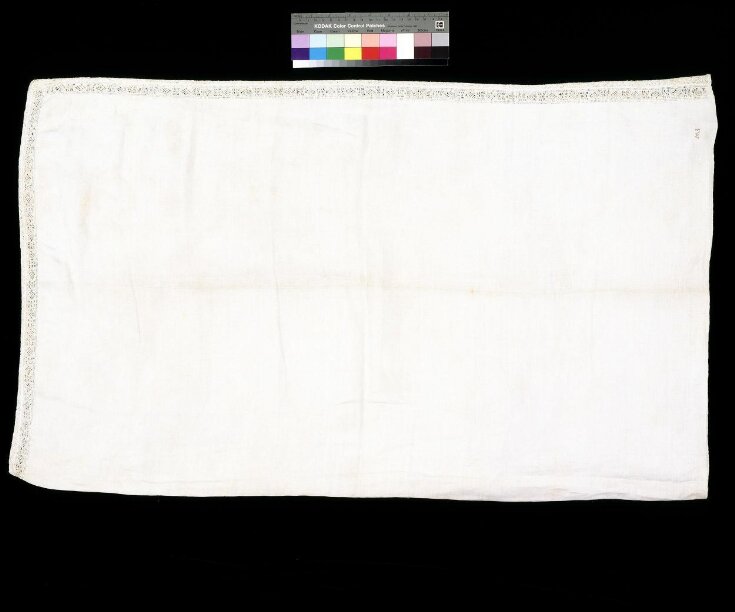
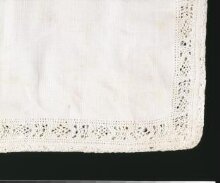
This pillowcase is made up from a rectangle of linen folded in half, with the selvedge (side edge of the fabric) at the open end making neat finished edges. The seams are decorated with narrow insertions of bobbin lace and whitework embroidery.
In the 17th century the fabric used for making into pillow cases and sheets was woven from flax or hemp. Flax made the best quality linen. Such linen, which was sometimes described as 'holland', or 'cambric', after the town of Cambrai, France, one of the original centres of production, was imported from The Netherlands, Flanders (now Belgium) and northern France. Most people would have had bed linen made from locally-grown, spun and bleached flax or hemp, however. Different parts of the plants produced fibres of differing quality, giving a range of sheeting from fine to very coarse and rough.
Materials & Making
This pillowcase is made up from a rectangle of linen folded in half, with the selvedge (side edge of the fabric) at the open end making neat finished edges. The seams are decorated with narrow insertions of bobbin lace and whitework embroidery.
Object details
| Categories | |
| Object type | |
| Materials and techniques | Linen, bobbin-lace insertions and whitework embroidery |
| Brief description | Linen pillow case with bobbin-lace insertions and whitework embroidery, England, 17th century |
| Physical description | Pillow case of plain woven white linen, formed from a rectangle of linen folded in half, and with selvedges at the open end. Narrow insertions of bobbin lace where the linen is seamed along the one short and one long side. The edges of the linen next to the insertion are further decorated with bands of needle weaving. The initials 'I W' are embroidered in cross stitch in black silk thread. Whitework embroidery. |
| Dimensions |
|
| Marks and inscriptions | 'I W' (Embroidered in cross stitch in black silk.) |
| Gallery label | British Galleries:
Much of this pillowcase may have been home made. The women of the household would have spun the linen thread and then sent it away for weaving. The woven linen was then cut and sewn at home, where the bobbin lace could also have been made. The initials IW embroidered on this pillowcase (top left) are the owner's.(27/03/2003) |
| Summary | Object Type In the 17th century the fabric used for making into pillow cases and sheets was woven from flax or hemp. Flax made the best quality linen. Such linen, which was sometimes described as 'holland', or 'cambric', after the town of Cambrai, France, one of the original centres of production, was imported from The Netherlands, Flanders (now Belgium) and northern France. Most people would have had bed linen made from locally-grown, spun and bleached flax or hemp, however. Different parts of the plants produced fibres of differing quality, giving a range of sheeting from fine to very coarse and rough. Materials & Making This pillowcase is made up from a rectangle of linen folded in half, with the selvedge (side edge of the fabric) at the open end making neat finished edges. The seams are decorated with narrow insertions of bobbin lace and whitework embroidery. |
| Collection | |
| Accession number | T.298-1965 |
About this object record
Explore the Collections contains over a million catalogue records, and over half a million images. It is a working database that includes information compiled over the life of the museum. Some of our records may contain offensive and discriminatory language, or reflect outdated ideas, practice and analysis. We are committed to addressing these issues, and to review and update our records accordingly.
You can write to us to suggest improvements to the record.
Suggest feedback
You can write to us to suggest improvements to the record.
Suggest feedback
| Record created | March 31, 1999 |
| Record URL |
Download as: JSONIIIF Manifest
