
1718-1720 (made)
| Artist/Maker | |
| Place of origin |
In the 18th century, women’s pockets were not sewn into their gowns. Instead they were attached to a tape and tied around the waist as separate garments. Worn under the hoops and petticoats, they were accessed through openings in the gown and petticoat seams.
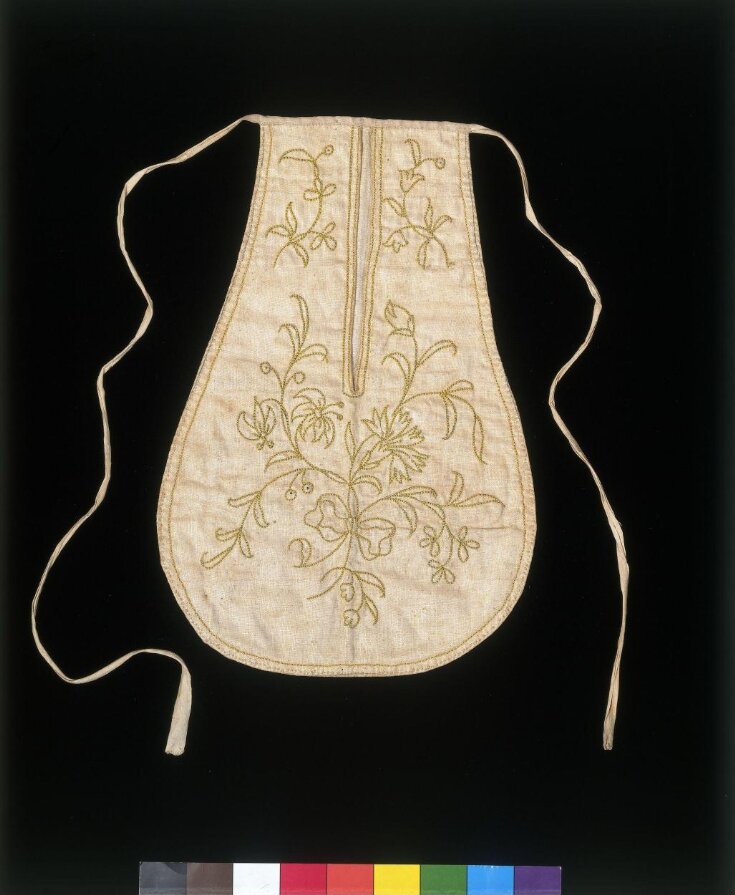
This is an example of a single pocket made of linen, embroidered with silk and bearing its original linen tie. Its small size and the short length of the opening and the tie suggest that it was made for a young girl. Yellow silk thread on white linen was a popular combination in British embroideries of the early 18th century, influenced by imported Indian embroideries. The use of backstitch can also be attributed to Indian needlework, although the pattern of the flowers reflects embroidery designs found on British accessories, such as aprons and gloves.
This pocket forms part of the Hannah Downes collection of needlework, executed by four generations of women between the late 17th and 19th centuries in Britain. The family tree identifies Hannah Haines, youngest daughter of Hannah Downes, as the maker of this pocket between 1718–1720.
This is an example of a single pocket made of linen, embroidered with silk and bearing its original linen tie. Its small size and the short length of the opening and the tie suggest that it was made for a young girl. Yellow silk thread on white linen was a popular combination in British embroideries of the early 18th century, influenced by imported Indian embroideries. The use of backstitch can also be attributed to Indian needlework, although the pattern of the flowers reflects embroidery designs found on British accessories, such as aprons and gloves.
This pocket forms part of the Hannah Downes collection of needlework, executed by four generations of women between the late 17th and 19th centuries in Britain. The family tree identifies Hannah Haines, youngest daughter of Hannah Downes, as the maker of this pocket between 1718–1720.
Object details
| Categories | |
| Object type | |
| Materials and techniques | Linen, hand sewn with linen thread, embroidered with silk thread, and linen tape |
| Brief description | Woman's pocket of linen embroidered with yellow silk, made by Hannah Haines, 1718-20, English |
| Physical description | A single pocket made of linen, embroidered in floral motifs with yellow silk, with a linen tape tie |
| Dimensions |
|
| Credit line | Given by the descendants of Hannah Downes |
| Object history | Given by the descendants of Hannah Downes and part of a collection of needlework executed by four generations of women. The family tree identifies Hannah Haines, youngest daughter of Hannah Downes, as the maker of this pocket between 1718-1720. Historical significance: An example of an early 18th century women's pocket, a separate garment worn tied around the waist under the petticoats. The small size of this pocket and the short length of its opening suggest that it was made for a young girl. |
| Summary | In the 18th century, women’s pockets were not sewn into their gowns. Instead they were attached to a tape and tied around the waist as separate garments. Worn under the hoops and petticoats, they were accessed through openings in the gown and petticoat seams. This is an example of a single pocket made of linen, embroidered with silk and bearing its original linen tie. Its small size and the short length of the opening and the tie suggest that it was made for a young girl. Yellow silk thread on white linen was a popular combination in British embroideries of the early 18th century, influenced by imported Indian embroideries. The use of backstitch can also be attributed to Indian needlework, although the pattern of the flowers reflects embroidery designs found on British accessories, such as aprons and gloves. This pocket forms part of the Hannah Downes collection of needlework, executed by four generations of women between the late 17th and 19th centuries in Britain. The family tree identifies Hannah Haines, youngest daughter of Hannah Downes, as the maker of this pocket between 1718–1720. |
| Collection | |
| Accession number | T.42-1935 |
About this object record
Explore the Collections contains over a million catalogue records, and over half a million images. It is a working database that includes information compiled over the life of the museum. Some of our records may contain offensive and discriminatory language, or reflect outdated ideas, practice and analysis. We are committed to addressing these issues, and to review and update our records accordingly.
You can write to us to suggest improvements to the record.
Suggest feedback
You can write to us to suggest improvements to the record.
Suggest feedback
| Record created | December 20, 2004 |
| Record URL |
Download as: JSONIIIF Manifest
