
Cap
16th century (made)
| Artist/Maker | |
| Place of origin |
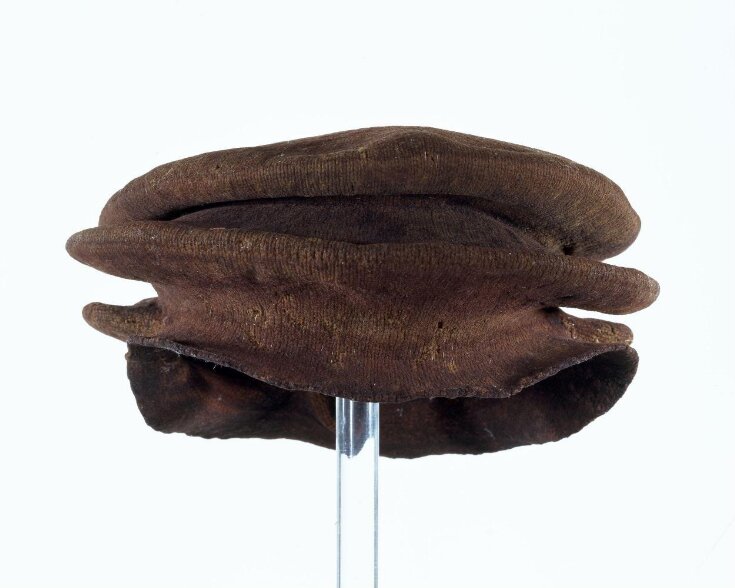
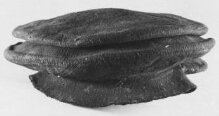
This cap was discovered in an old house in Worship Street, East London. It is knitted with thick, reddish brown wool in stocking stitch. It has been felted, cut and re-sewn to make two overlapping brims, and blocked into its finished form.
Excavations of late medieval and Renaissance artefacts have revealed a large number of similar caps. They were an important item of everyday clothing and are mentioned in a law called the Cappers Act of 1571. This decreed the type of headgear that every English resident over the age of six and below the rank of 'gentleman' should wear on Sundays and holidays. It specified ‘a cap of wool, thickened and dressed in England, made within this realm and only dressed and finished by some of the trade of cappers, upon pain to forfeit for every day of not wearing 3s. 4d’. The aim of this Act of Parliament was to protect the trade of cap-making.
Excavations of late medieval and Renaissance artefacts have revealed a large number of similar caps. They were an important item of everyday clothing and are mentioned in a law called the Cappers Act of 1571. This decreed the type of headgear that every English resident over the age of six and below the rank of 'gentleman' should wear on Sundays and holidays. It specified ‘a cap of wool, thickened and dressed in England, made within this realm and only dressed and finished by some of the trade of cappers, upon pain to forfeit for every day of not wearing 3s. 4d’. The aim of this Act of Parliament was to protect the trade of cap-making.
Object details
| Categories | |
| Object type | |
| Parts | This object consists of 2 parts.
|
| Materials and techniques | Knitted and felted wool |
| Brief description | Wool, knitted and fulled, with layered brims, English, 1500s |
| Physical description | Felted cap knitted in thick reddish brown wool with two overlapping brims. |
| Dimensions |
|
| Gallery label | 9. CAP
Hand-knitted wool
English, 16th century
This cap was partly knitted to shape, then heavily felted, cut, sewn and blocked. One of the earliest mentions of such a cap is in an Act of 1488 which fixed the price of felted wool hats at 1s.8d and of knitted wool caps at 2s.8d. By the Capper's Act of 1571 it was laid down that everyone over the age of six (excepting 'maids, ladies, gentlewomen, noble personages, and every Lord, Knight, and gentleman of twenty marks land') should wear on Sundays and holidays 'a cap of wool, thicked and dressed in England, made within this realm, and only dressed and finished by some of the trade of cappers, upon pain to forfeit for every day of not wearing 3s 4d.'
1562-1901 |
| Summary | This cap was discovered in an old house in Worship Street, East London. It is knitted with thick, reddish brown wool in stocking stitch. It has been felted, cut and re-sewn to make two overlapping brims, and blocked into its finished form. Excavations of late medieval and Renaissance artefacts have revealed a large number of similar caps. They were an important item of everyday clothing and are mentioned in a law called the Cappers Act of 1571. This decreed the type of headgear that every English resident over the age of six and below the rank of 'gentleman' should wear on Sundays and holidays. It specified ‘a cap of wool, thickened and dressed in England, made within this realm and only dressed and finished by some of the trade of cappers, upon pain to forfeit for every day of not wearing 3s. 4d’. The aim of this Act of Parliament was to protect the trade of cap-making. |
| Bibliographic references |
|
| Collection | |
| Accession number | 1562&A-1901 |
About this object record
Explore the Collections contains over a million catalogue records, and over half a million images. It is a working database that includes information compiled over the life of the museum. Some of our records may contain offensive and discriminatory language, or reflect outdated ideas, practice and analysis. We are committed to addressing these issues, and to review and update our records accordingly.
You can write to us to suggest improvements to the record.
Suggest feedback
You can write to us to suggest improvements to the record.
Suggest feedback
| Record created | December 13, 2004 |
| Record URL |
Download as: JSONIIIF Manifest
