Betel Box
3rd quarter 19th century (made)
| Artist/Maker | |
| Place of origin |
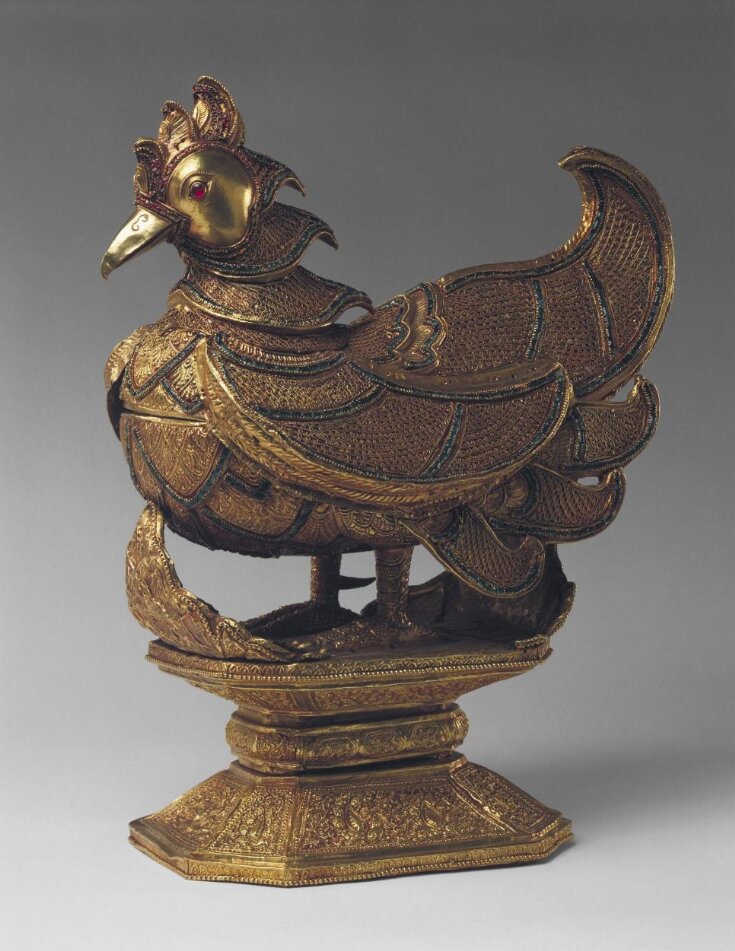
This gold and jewelled container once formed part of the regalia of King Thibaw, the last Burmese king (r.1878-1885). The karaweik, a mythical bird, is a symbol of longevity. The container was used at the royal palace at Mandalay as part of a betel paraphernalia set. The offering of betel--a mildly narcotic chewing quid--was an essential element of traditional Burmese society. Every household, including the royal family's, had a set of utensils for its preparation. Betel leaves, used to wrap the blend of areca-nut shavings, lime and spices, were stored in the karaweik container.
This object was given to the Museum by the Government and people of Burma in generous recognition of the Victoria and Albert Museum's safekeeping of the Burmese royal regalia from 1886 to 1964.
This object was given to the Museum by the Government and people of Burma in generous recognition of the Victoria and Albert Museum's safekeeping of the Burmese royal regalia from 1886 to 1964.
Delve deeper
Discover more about this object

Object details
| Categories | |
| Object type | |
| Parts | This object consists of 2 parts.
|
| Materials and techniques | Filigree work in gold on a gold ground, outlined with bands of rubies and imitation emeralds, with some embossing; eyes of rubies (one now missing) |
| Brief description | Burmese royal kun-it (betel box) on a stand in the shape of a karaweik or mythical bird, Konbaung Dynasty (1752-1885), ca. 1850-1875 |
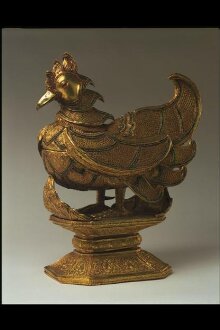
| Physical description | A vessel and cover on a stand, in the shape of a karaweik (a mythical Burmese bird). Chicken-like in appearance with its feet, pointed beak, wealth of overlapping body feathers, curled wings and upturned tail. The bird has spurs on its feet. The waisted stand is decorated with panels of floral ornament and at each end a leaf-shaped extension with foliage motifs, curves upwards to support the body of the stand. |
| Dimensions |
|
| Style | |
| Production type | Unique |
| Gallery label |
|
| Credit line | Presented by the Government of Burma in generous recognition of the Victoria and Albert Museum's safekeeping of the Mandalay Regalia (1886 to 1964). |
| Object history | The container formed part of the Burmese royal regalia which belonged to King Thi-baw, who was the last representative of the Burmese monarchy. The regalia was part of the material requisitioned as indemnity at the end of the third Burmese war in 1885. It was later placed under the custodianship of the Museum (IS.144 to 294-1890). It was returned to the Government of Burma in 1964 except for the Karaweik (IS.159-1890, now numbered IS.246&A-1964). This was given to the British Government by Ne Win at the time to be kept by the V&A as a token of friendship and goodwill. |
| Historical context | Yule, Capt (later Col. Sir) Henry.Narrative of the Mission to The Court of Ava in 1855 London: Smith, Elder, and Co., frontispiece (illustration of similar karaweik as seen in the royal regalia of King Mindon). |
| Subjects depicted | |
| Summary | This gold and jewelled container once formed part of the regalia of King Thibaw, the last Burmese king (r.1878-1885). The karaweik, a mythical bird, is a symbol of longevity. The container was used at the royal palace at Mandalay as part of a betel paraphernalia set. The offering of betel--a mildly narcotic chewing quid--was an essential element of traditional Burmese society. Every household, including the royal family's, had a set of utensils for its preparation. Betel leaves, used to wrap the blend of areca-nut shavings, lime and spices, were stored in the karaweik container. This object was given to the Museum by the Government and people of Burma in generous recognition of the Victoria and Albert Museum's safekeeping of the Burmese royal regalia from 1886 to 1964. |
| Bibliographic references |
|
| Other number | IS.159-1890 - Previous number |
| Collection | |
| Accession number | IS.246&A-1964 |
About this object record
Explore the Collections contains over a million catalogue records, and over half a million images. It is a working database that includes information compiled over the life of the museum. Some of our records may contain offensive and discriminatory language, or reflect outdated ideas, practice and analysis. We are committed to addressing these issues, and to review and update our records accordingly.
You can write to us to suggest improvements to the record.
Suggest feedback
You can write to us to suggest improvements to the record.
Suggest feedback
| Record created | March 25, 1999 |
| Record URL |
Download as: JSONIIIF Manifest
