Needlecase and Scissors
| Artist/Maker |
Object Type
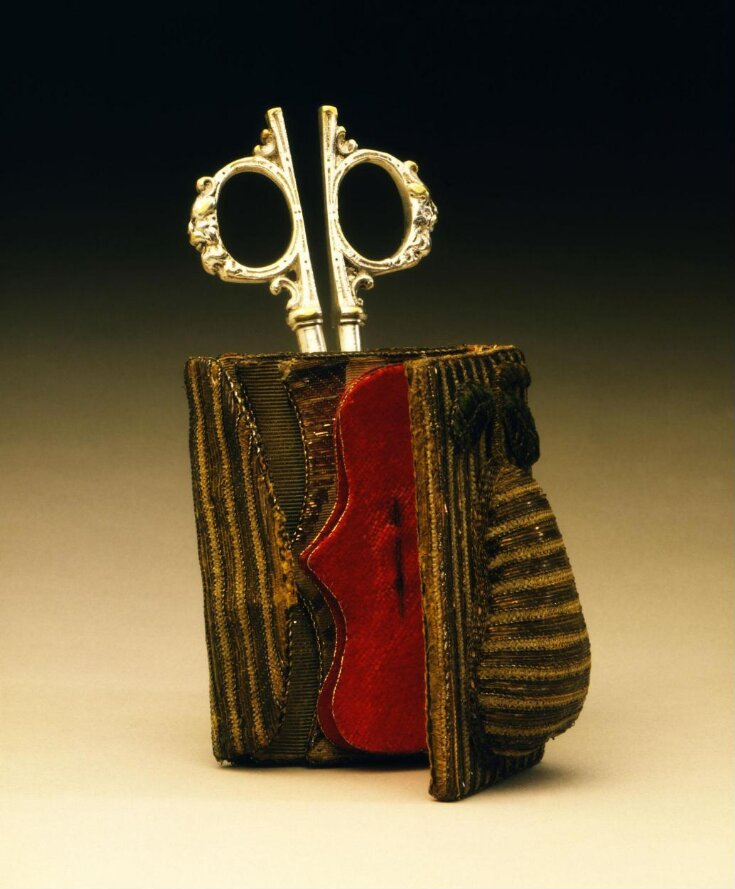
This needle case has been made by assembling fragments of rich dress fabrics which would have been kept for this purpose. Women of all classes of society would have made such needlecases; only the materials used would have varied. Both practical and decorative needlework played an important part in women's lives, in the management of households and in the making, mending and decoration of clothes. Steel needles were essential equipment, and were carefully stored in such decorated needle cases.
Materials & Making
The needle case has been constructed as a folder with leaves and pockets inside. The outside is covered in a silk and linen fabric closely striped with metal strip. One side has a pear shape in semi-relief, with green velvet appliqué leaves. The other side has a pocket containing scissors. On the inside is a mirror, bound with gilt braid; two leaves of red felted wool, scalloped and edged with twisted gilt thread, attached to the case by being sewn onto a piece of pink ribbon; and two pockets covered in a fragment of rich dress silk brocaded with strips of silver thread. Other fabrics which appear in the linings are plain-woven green and pink silks, and unpatterned silver tissue.
This needle case has been made by assembling fragments of rich dress fabrics which would have been kept for this purpose. Women of all classes of society would have made such needlecases; only the materials used would have varied. Both practical and decorative needlework played an important part in women's lives, in the management of households and in the making, mending and decoration of clothes. Steel needles were essential equipment, and were carefully stored in such decorated needle cases.
Materials & Making
The needle case has been constructed as a folder with leaves and pockets inside. The outside is covered in a silk and linen fabric closely striped with metal strip. One side has a pear shape in semi-relief, with green velvet appliqué leaves. The other side has a pocket containing scissors. On the inside is a mirror, bound with gilt braid; two leaves of red felted wool, scalloped and edged with twisted gilt thread, attached to the case by being sewn onto a piece of pink ribbon; and two pockets covered in a fragment of rich dress silk brocaded with strips of silver thread. Other fabrics which appear in the linings are plain-woven green and pink silks, and unpatterned silver tissue.
Object details
| Categories | |
| Object type | |
| Parts | This object consists of 2 parts.
|
| Materials and techniques | Embroidered silk, velvet and flannel, with glass mirror, silver-plated brass with steel blades |
| Brief description | Needlecase of silk and metal thread, made in England, with silver-plated brass and steel scissors, probably made in the Netherlands, second half 17th century |
| Physical description | Needlecase and scissors. |
| Dimensions | scissors 9.5 x 5cm |
| Gallery label | British Galleries:
A skilled needlewoman might have made this little case for herself, or as a gift. She used scraps of silk dress fabrics and pieces of red wool. The case contains pockets for scissors, a small mirror, and other sewing tools. It also still contains two needles, pinned inside.(27/03/2003) |
| Summary | Object Type This needle case has been made by assembling fragments of rich dress fabrics which would have been kept for this purpose. Women of all classes of society would have made such needlecases; only the materials used would have varied. Both practical and decorative needlework played an important part in women's lives, in the management of households and in the making, mending and decoration of clothes. Steel needles were essential equipment, and were carefully stored in such decorated needle cases. Materials & Making The needle case has been constructed as a folder with leaves and pockets inside. The outside is covered in a silk and linen fabric closely striped with metal strip. One side has a pear shape in semi-relief, with green velvet appliqué leaves. The other side has a pocket containing scissors. On the inside is a mirror, bound with gilt braid; two leaves of red felted wool, scalloped and edged with twisted gilt thread, attached to the case by being sewn onto a piece of pink ribbon; and two pockets covered in a fragment of rich dress silk brocaded with strips of silver thread. Other fabrics which appear in the linings are plain-woven green and pink silks, and unpatterned silver tissue. |
| Collection | |
| Accession number | T.424&A-1988 |
About this object record
Explore the Collections contains over a million catalogue records, and over half a million images. It is a working database that includes information compiled over the life of the museum. Some of our records may contain offensive and discriminatory language, or reflect outdated ideas, practice and analysis. We are committed to addressing these issues, and to review and update our records accordingly.
You can write to us to suggest improvements to the record.
Suggest feedback
You can write to us to suggest improvements to the record.
Suggest feedback
| Record created | March 23, 1999 |
| Record URL |
Download as: JSONIIIF Manifest
