
Theatre Costume
1966 (made)
| Artist/Maker | |
| Place of origin |
Ram Gopal was one of the most important dancers of the 20th century. He was a major figure in the revival of Indian dance and his spectacular theatrical presentations introduced it to audiences both in Asia and the West. He was proud of the authenticity of his music, costuming and style, shrewdly tailored his presentations to Western audiences, using modern theatrical techniques and spectacular presentation.
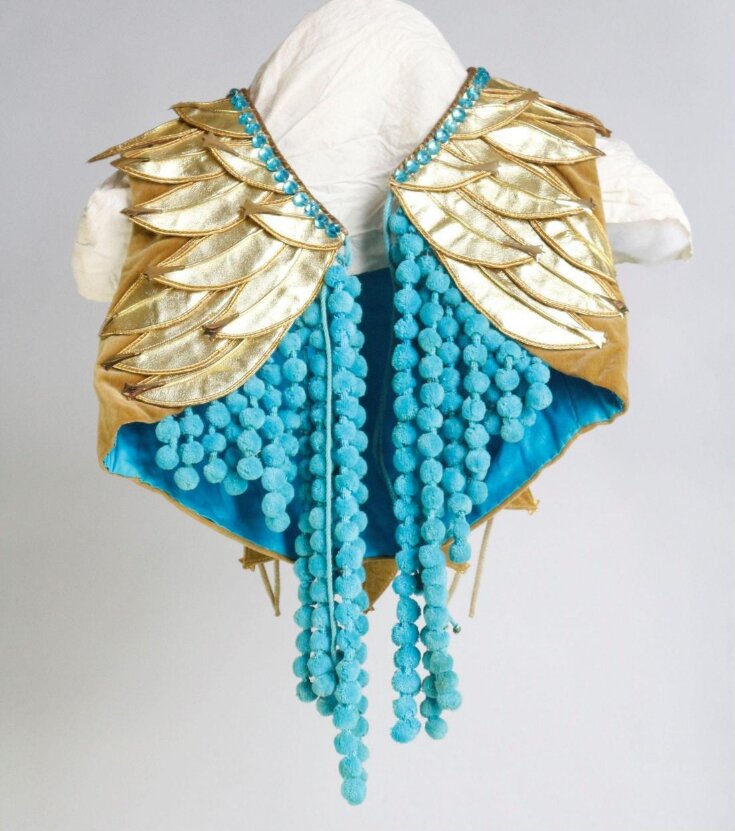
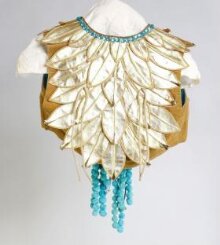
This costume was worn by Gopal in The Eagle Dance, one of his most famous solos; in it he portrayed Garuda, the sacred golden eagle of Lord Vishnu, whose mission was to destroy the Naga (snake) people, for which Vishnu rewarded him with immortality. The costume is made of gold leather, cut into 'feathers' and lotus shapes, trimmed with brilliant blue, and under the stage lights would have shone with a sun-like radiance entirely fitted to a servant of a god.
Such costumes were expensive, some were insured for as much as £25,000, and they had to be carefully looked after. Thus, the wings and headdress for this costume had specially designed carrying cases to protect them on the long journeys between engagements.
This costume was worn by Gopal in The Eagle Dance, one of his most famous solos; in it he portrayed Garuda, the sacred golden eagle of Lord Vishnu, whose mission was to destroy the Naga (snake) people, for which Vishnu rewarded him with immortality. The costume is made of gold leather, cut into 'feathers' and lotus shapes, trimmed with brilliant blue, and under the stage lights would have shone with a sun-like radiance entirely fitted to a servant of a god.
Such costumes were expensive, some were insured for as much as £25,000, and they had to be carefully looked after. Thus, the wings and headdress for this costume had specially designed carrying cases to protect them on the long journeys between engagements.
Object details
| Categories | |
| Object type | |
| Parts | This object consists of 8 parts. (Some alternative part names are also shown below)
|
| Brief description | Costume for the Eagle Dance worn by Ram Gopal (1912?-2003) |
| Gallery label | 18
HEADDRESS FOR THE EAGLE GOD IN GARUDA
1966
Garuda was one of Ram Gopal’s most popular dances from the time of his first appearance in London in 1939. In the performance, the Eagle God makes a daily journey to the heavens to obtain amrit, the food of the gods. The helmet, with overlapping gold leather ‘feathers’ and the gold metal lotus motifs, represents the winged eagle.
Leather, metal, synthetic silk, glass, foam rubber and elastic
Designed and made by Jenny Levy Casperson
Given by the Trustees of the Ram Gopal Estate
Museum no. S.111:3-2004
(March 2009) |
| Credit line | Given by the Trustees of the Ram Gopal Estate |
| Object history | The Eagle Dance was one of Ram Gopal's most famous dances in which Garuda; the sacred golden eagle of Lord Vishnu swoops to earth to destroy the Naga (snake) people; Vishnu rewards him with the nectar of immortality. |
| Historical context | Ram Gopal (1912?-2003) and Uday Shankar, were the most important Indian dancers of the 20th century. Gopal built on Shankar’s pioneering revival of Indian dance and its introduction to audiences both in Asia and the West, taking it one stage further. He remained faithful to the pure discipline, technique and ethos of Indian classical. but he also started to open out a deeper appreciation of Indian classical dance traditions, shrewdly tailored to Western audiences, using modern theatrical techniques and spectacular presentation. He widened audiences experiences by including music and other folk and classical styles alongside his own pieces. Each item was preceded by an explanation, enabling audiences to understand and appreciate what was, at that time, a very esoteric art form. For three decades he was a major world star, with a glamour and charisma equal to any other major dance star of the period. He not only raised public awareness of the richness of Indian dance but worked with dancers trained in other dance forms, like Alicia Markova, thus setting a precedent in Britain for the current thriving and creative South Asian dance scene, which mixes classical Indian dance with other contemporary and classical dance styles to create something uniquely itself. Each of Gopal’s costumes was hand made and tailored to his own design. He spent huge sums on his costumes, which could be insured for as much as £25,000. Some were made of cloth of gold, woven and tailored in India; when it became worn, it was sent back to India, melted down and rewoven. |
| Summary | Ram Gopal was one of the most important dancers of the 20th century. He was a major figure in the revival of Indian dance and his spectacular theatrical presentations introduced it to audiences both in Asia and the West. He was proud of the authenticity of his music, costuming and style, shrewdly tailored his presentations to Western audiences, using modern theatrical techniques and spectacular presentation. This costume was worn by Gopal in The Eagle Dance, one of his most famous solos; in it he portrayed Garuda, the sacred golden eagle of Lord Vishnu, whose mission was to destroy the Naga (snake) people, for which Vishnu rewarded him with immortality. The costume is made of gold leather, cut into 'feathers' and lotus shapes, trimmed with brilliant blue, and under the stage lights would have shone with a sun-like radiance entirely fitted to a servant of a god. Such costumes were expensive, some were insured for as much as £25,000, and they had to be carefully looked after. Thus, the wings and headdress for this costume had specially designed carrying cases to protect them on the long journeys between engagements. |
| Collection | |
| Accession number | S.111:1 to 8-2004 |
About this object record
Explore the Collections contains over a million catalogue records, and over half a million images. It is a working database that includes information compiled over the life of the museum. Some of our records may contain offensive and discriminatory language, or reflect outdated ideas, practice and analysis. We are committed to addressing these issues, and to review and update our records accordingly.
You can write to us to suggest improvements to the record.
Suggest feedback
You can write to us to suggest improvements to the record.
Suggest feedback
| Record created | October 27, 2004 |
| Record URL |
Download as: JSONIIIF Manifest
