
Minerva
Cameo
ca. 1780 (made)
ca. 1780 (made)
| Artist/Maker | |
| Place of origin |
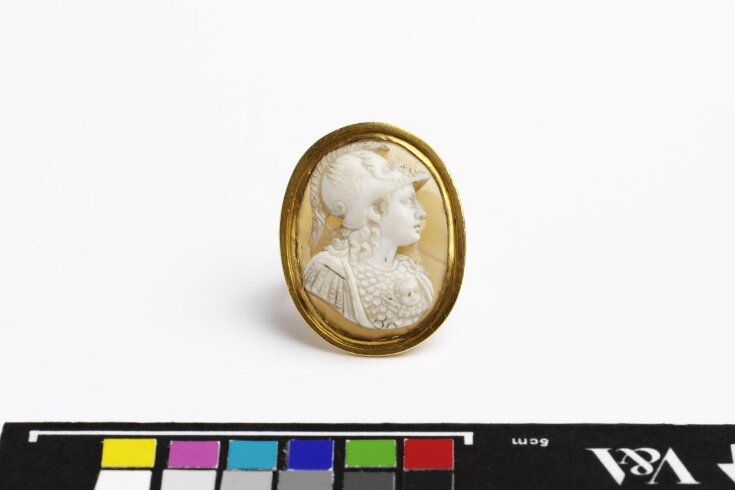
The art of engraving gemstones can be traced back to ancient Greece in the 8th century BC and earlier. Techniques passed down to the Egyptians and then to the Romans. There were major revivals of interest in engraved gems in Europe during the Byantine era, the Middle Ages, the Renaissance, and again in the 18th and 19th centuries. At each stage cameos and intaglios, these skillful carvings on a minute scale, were much prized and collected, sometimes as symbols of power mounted in jewelled settings, sometimes as small objects for private devotion or enjoyment. This gem is in the neo-classical style popular in the late 1700s and early 1800s, when taste in the arts echoed the subject matter and style of the Greek and Roman masters. Thousands of gems were made in this style in Italy and brought back by British Grand Tourists, who went there to visit the newly-discovered classical antiquities and archaeological sites. Minerva, known as Pallas Athena in Greek mythology, was one of the major deities, the daughter of Jupiter. In one of her main aspects, that of goddess of war, she fights for just causes and is shown in armour, with shield, spear and helmet.
Object details
| Categories | |
| Object type | |
| Title | Minerva (generic title) |
| Materials and techniques | engraved gemstone set in gold ring; White over pale brown layered agate, variety 'sardonyx'. |
| Brief description | Cameo, oval sardonyx in two strata, set in gold ring, depicting Minerva, Italy, ca. 1780 |
| Physical description | Vertical oval cameo. Depicts bust of Minerva facing right, wearing armour and a helmet. |
| Dimensions |
|
| Style | |
| Credit line | Townshend Bequest |
| Object history | This gem was part of the collection of the Reverend Chauncy Hare Townshend (1798-1868), who bequeathed his important collection to the South Kensington Museum in 1869. Although the gemstone collection is not as comprehensive as that found at the Natural History Museum, it is of particular historic interest as its formation pre-dates the development of many synthetic stones and artificial enhancements. All the stones were mounted as rings before they came to the Museum. Some are held in the Sculpture Section, other more elaborately mounted ones in the Metalwork Section. As well as being a clergyman, collector and dillettante, the Reverend Townshend wrote poetry. He met Robert Southey in 1815 and through him the Wordsworths, the Coleridges and John Clare. He was a friend of Charles Dickens and dedicatee of his novel 'Great Expectations'. |
| Historical context | Engraved gemstones based on classical models were widely produced and collected in Italy in the eighteenth century. Many were brought back by British Grand Tourists, and important collections were formed. |
| Production | Attribution note: White over pale brown translucent chalcedonies. |
| Subject depicted | |
| Summary | The art of engraving gemstones can be traced back to ancient Greece in the 8th century BC and earlier. Techniques passed down to the Egyptians and then to the Romans. There were major revivals of interest in engraved gems in Europe during the Byantine era, the Middle Ages, the Renaissance, and again in the 18th and 19th centuries. At each stage cameos and intaglios, these skillful carvings on a minute scale, were much prized and collected, sometimes as symbols of power mounted in jewelled settings, sometimes as small objects for private devotion or enjoyment. This gem is in the neo-classical style popular in the late 1700s and early 1800s, when taste in the arts echoed the subject matter and style of the Greek and Roman masters. Thousands of gems were made in this style in Italy and brought back by British Grand Tourists, who went there to visit the newly-discovered classical antiquities and archaeological sites. Minerva, known as Pallas Athena in Greek mythology, was one of the major deities, the daughter of Jupiter. In one of her main aspects, that of goddess of war, she fights for just causes and is shown in armour, with shield, spear and helmet. |
| Bibliographic references |
|
| Collection | |
| Accession number | 1805-1869 |
About this object record
Explore the Collections contains over a million catalogue records, and over half a million images. It is a working database that includes information compiled over the life of the museum. Some of our records may contain offensive and discriminatory language, or reflect outdated ideas, practice and analysis. We are committed to addressing these issues, and to review and update our records accordingly.
You can write to us to suggest improvements to the record.
Suggest feedback
You can write to us to suggest improvements to the record.
Suggest feedback
| Record created | October 18, 2004 |
| Record URL |
Download as: JSONIIIF Manifest
