Candlestick
1776-1777 (made)
| Artist/Maker | |
| Place of origin |
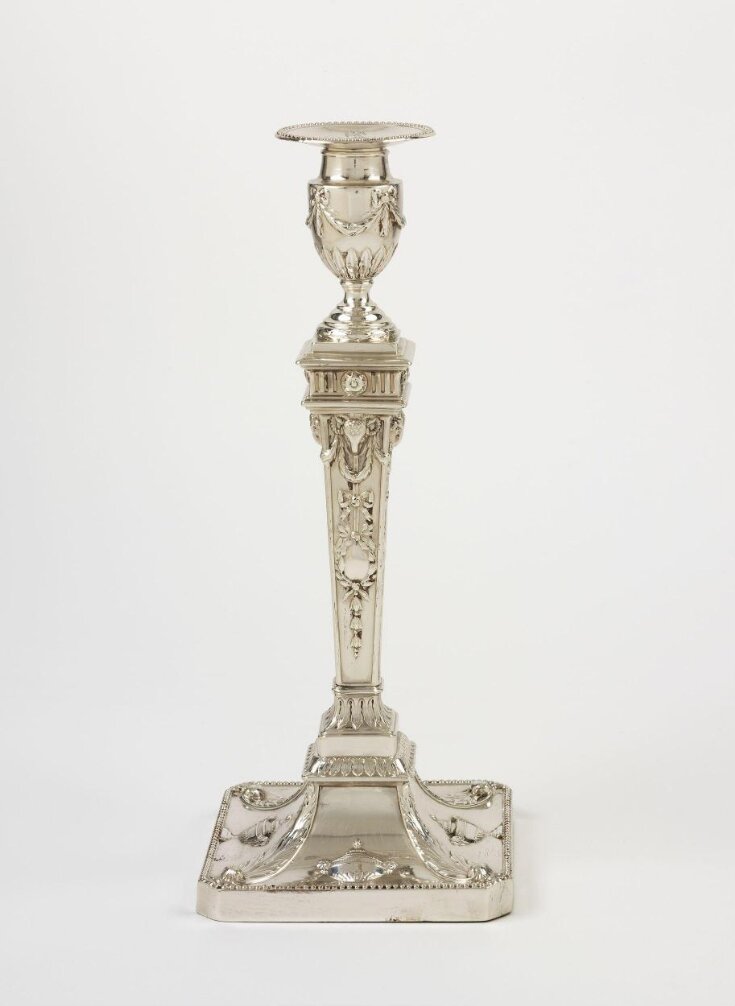
These candlesticks bear the mark of John Carter II, a London silversmith who specialised almost exclusively in candlesticks and salvers. He entered his first mark in 1776, the year these candlesticks were made but earlier also supplied his products to the celebrated workshop of John Parker and Edward Wakelin.
The candlesticks show also that although the silver trade was threatened by the manufacturers of cheaper substitutes, it also benefitted from their technologies. Before the late 18th century the decoration on these candlesticks would have been either chased on (pressed into shape using a fine tool called a burin) which was time consuming, or cast in a thickier gauge of silver, which was expensive. Here the candlesticks have been made using technology developed by the makers of Sheffield Plate and the sides of the candlesticks and the panels of the base have been stamped in the same shaped die four times and then soldered together. The technology was expensive, but once installed could rapidly increase productivity.
The candlesticks show also that although the silver trade was threatened by the manufacturers of cheaper substitutes, it also benefitted from their technologies. Before the late 18th century the decoration on these candlesticks would have been either chased on (pressed into shape using a fine tool called a burin) which was time consuming, or cast in a thickier gauge of silver, which was expensive. Here the candlesticks have been made using technology developed by the makers of Sheffield Plate and the sides of the candlesticks and the panels of the base have been stamped in the same shaped die four times and then soldered together. The technology was expensive, but once installed could rapidly increase productivity.
Object details
| Categories | |
| Object type | |
| Parts | This object consists of 8 parts.
|
| Materials and techniques | Silver, die-stamped and soldered |
| Brief description | Set of four silver candlesticks in the form of neoclassical columns, mark of John Carter II, Sheffield, 1776-7 |
| Physical description | Set of four candlesticks each in the form of a classical column on a square base with blunted corners, with stem tapering upwards also of square section supporting an urn shaped socket. The base is stamped with urns and leaves, the stem with rams' heads from which hang wreaths and ribbons, and the socket is stamped with leaves and festoons. The socket and base also have beaded borders. The sides of the base and the sockets bear the hallmarks. |
| Dimensions |
|
| Style | |
| Production type | Mass produced |
| Marks and inscriptions |
|
| Credit line | Bequeathed by R. J. Dyson, Esq. |
| Object history | Bequest - R J Dyson, Esq. / Acquisition RF: 43 / 1020 These candlesticks bear the mark of John Carter II, a London silversmith who specialised almost exclusively in candlesticks and salvers. He entered his first mark in 1776, the year these candlesticks were made but earlier also supplied his products to the celebrated workshop of John Parker and Edward Wakelin. Historical significance: The candlesticks were made at an interesting turning point in the history of the metal trades in Britain. The Sheffield Assay Ofiice had only opened in 1773, three years earlier than these sticks were produced. The establishment of the Sheffield and Birmingham offices reflected a dispersing of the trade away from London as well as an acknowledgement that cheaper plated wares were cutting into the silver market. No longer would Sheffield silver have to be sent to London or Chester for testing and the subsequent reduction in cost could be passed to the customer. These sticks show how silversmiths adopted technology developed by the makers of Sheffield Plate, a cheaper subsititute of silver-plated copper. Rather than being laboriously chased by hand or expensively cast in silver, the sides of the candlesticks and panels of the base have been stamped in the same shaped die four times and then soldered together. The technology was costly, but once installed could rapidly increase productivity. |
| Production | Attribution note: Retail |
| Summary | These candlesticks bear the mark of John Carter II, a London silversmith who specialised almost exclusively in candlesticks and salvers. He entered his first mark in 1776, the year these candlesticks were made but earlier also supplied his products to the celebrated workshop of John Parker and Edward Wakelin. The candlesticks show also that although the silver trade was threatened by the manufacturers of cheaper substitutes, it also benefitted from their technologies. Before the late 18th century the decoration on these candlesticks would have been either chased on (pressed into shape using a fine tool called a burin) which was time consuming, or cast in a thickier gauge of silver, which was expensive. Here the candlesticks have been made using technology developed by the makers of Sheffield Plate and the sides of the candlesticks and the panels of the base have been stamped in the same shaped die four times and then soldered together. The technology was expensive, but once installed could rapidly increase productivity. |
| Bibliographic reference | Angus Patterson, "A Timely Acquisition: The V&A's Matthew Boulton Pattern Book, ca. 1779", Journal of the Antique Metalware Society, Vol. 17, June 2009, pp. 58-75, p. 63 ill. |
| Collection | |
| Accession number | M.23 toC-1943 |
About this object record
Explore the Collections contains over a million catalogue records, and over half a million images. It is a working database that includes information compiled over the life of the museum. Some of our records may contain offensive and discriminatory language, or reflect outdated ideas, practice and analysis. We are committed to addressing these issues, and to review and update our records accordingly.
You can write to us to suggest improvements to the record.
Suggest feedback
You can write to us to suggest improvements to the record.
Suggest feedback
| Record created | September 10, 2004 |
| Record URL |
Download as: JSONIIIF Manifest
