Furnishing Fabric
1685-1700 (made)
| Artist/Maker | |
| Place of origin |
Object Type
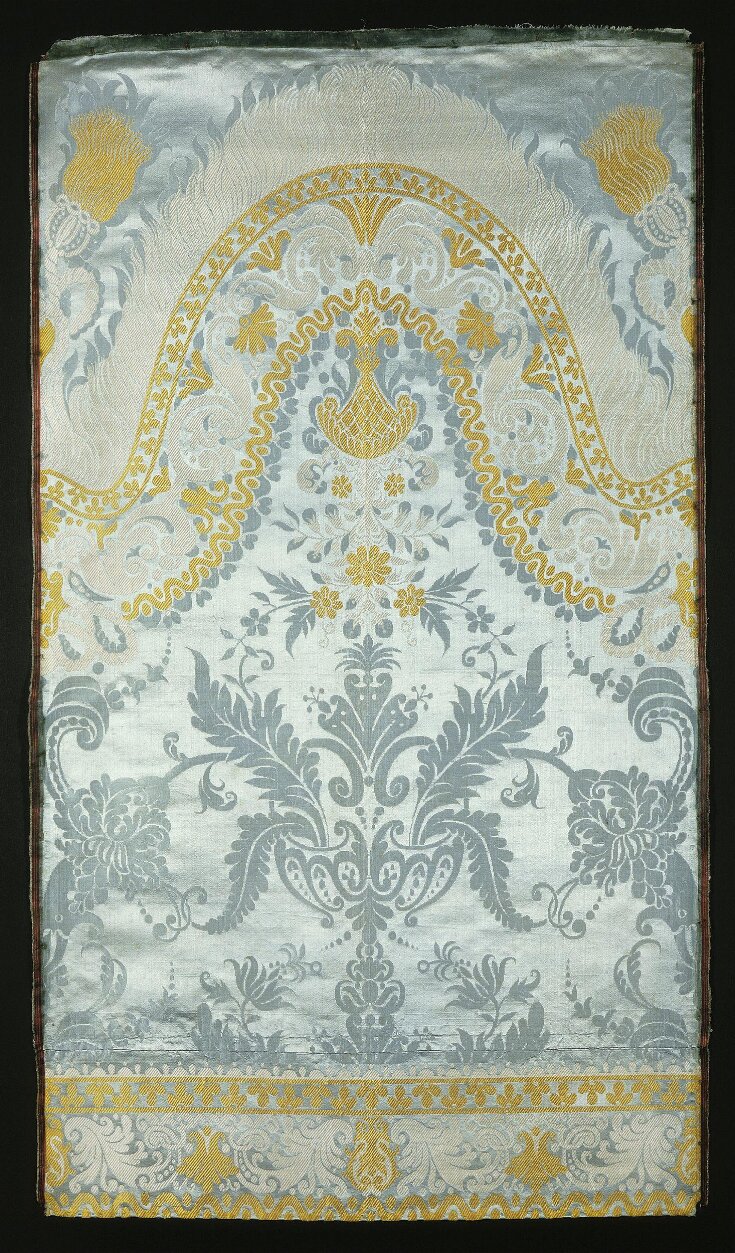
This length of silk furnishing fabric has been woven with a pattern simulating a three-dimensional swagged valance. In a clever optical effect the valance appears to be hung with tassels and looped cords, and to be draped over a damask ground.
Design & Designing
The pattern in this silk has a mirror repeat, and this panel would have been hung vertically with other panels to form a continuous line of swags. Such a design could have been used for bed hangings, but this piece has traces of glue along its sides and lower edge, indicating it was probably attached to a wall.
Place
A previous owner of the silk believed that it was made by Huguenot silk weavers in Ireland. It is almost certainly not Irish because there is no evidence of a silk industry in Ireland in this period which mught have produced a silk of such quality. However, it is also possible that it could be English. However, there are similarly no English silks known of this date, with firm provenance, that are of such high quality, and it is more likely to have been woven in France. Such silks were certainly used in England and Ireland.
This length of silk furnishing fabric has been woven with a pattern simulating a three-dimensional swagged valance. In a clever optical effect the valance appears to be hung with tassels and looped cords, and to be draped over a damask ground.
Design & Designing
The pattern in this silk has a mirror repeat, and this panel would have been hung vertically with other panels to form a continuous line of swags. Such a design could have been used for bed hangings, but this piece has traces of glue along its sides and lower edge, indicating it was probably attached to a wall.
Place
A previous owner of the silk believed that it was made by Huguenot silk weavers in Ireland. It is almost certainly not Irish because there is no evidence of a silk industry in Ireland in this period which mught have produced a silk of such quality. However, it is also possible that it could be English. However, there are similarly no English silks known of this date, with firm provenance, that are of such high quality, and it is more likely to have been woven in France. Such silks were certainly used in England and Ireland.
Object details
| Categories | |
| Object type | |
| Materials and techniques | Silk damask, brocaded and satin twill |
| Brief description | Silk furnishing fabric, probably woven in Lyon (France) or possibly in Spitalfields (London), 1685-1700 |
| Physical description | Furnishing fabric of pale blue silk damask in a formal baroque floral design, with supplementary wefts of yellow and white silk making a pattern simulating a three-dimensional textile swag hung with two tassels on looped cords lying on top of the damask. This panel, with the design in point repeat, would have been hung vertically with other panels to form a continuous line of swags. Structure: damask woven as 4 & 1 satin, with 2 supplementary pattern wefts in yellow and white. Also some brocading in yellow. The pattern wefts are bound with the satin warp in twill. Proportion of ground to supplementary wefts 2:1. Selvedges are intact, with 3 red and 2 yellow stripes, and top edge is hemmed. At the upper end, a narrow separate piece has been sewn on to the main piece with a border of yellow and white stylised flower and leaf shapes. It looks as if it was originally continuous with the main piece, as the pattern either side of the seam nearly matches up. A small band may have been cut out to reduce the height of the panel. |
| Dimensions |
|
| Gallery label | British Galleries:
The court designer Daniel Marot (about 1663-1752) produced several engraved designs for rooms with a horizontal line of fringed valances round the top of the fabric-hung walls. This appears to be a silk designer's idea for creating such an effect with a single fabric.(27/03/2003) |
| Object history | Purchased. Registered File number 1985/1094. The design could have been used for bed hangings, but this piece has traces of glue along its sides and lower edge, indicating it was probably attached to the wall. |
| Subjects depicted | |
| Summary | Object Type This length of silk furnishing fabric has been woven with a pattern simulating a three-dimensional swagged valance. In a clever optical effect the valance appears to be hung with tassels and looped cords, and to be draped over a damask ground. Design & Designing The pattern in this silk has a mirror repeat, and this panel would have been hung vertically with other panels to form a continuous line of swags. Such a design could have been used for bed hangings, but this piece has traces of glue along its sides and lower edge, indicating it was probably attached to a wall. Place A previous owner of the silk believed that it was made by Huguenot silk weavers in Ireland. It is almost certainly not Irish because there is no evidence of a silk industry in Ireland in this period which mught have produced a silk of such quality. However, it is also possible that it could be English. However, there are similarly no English silks known of this date, with firm provenance, that are of such high quality, and it is more likely to have been woven in France. Such silks were certainly used in England and Ireland. |
| Collection | |
| Accession number | T.530-1985 |
About this object record
Explore the Collections contains over a million catalogue records, and over half a million images. It is a working database that includes information compiled over the life of the museum. Some of our records may contain offensive and discriminatory language, or reflect outdated ideas, practice and analysis. We are committed to addressing these issues, and to review and update our records accordingly.
You can write to us to suggest improvements to the record.
Suggest feedback
You can write to us to suggest improvements to the record.
Suggest feedback
| Record created | February 23, 1999 |
| Record URL |
Download as: JSONIIIF Manifest
