Furnishing Fabric
1680-1700 (made)
| Artist/Maker | |
| Place of origin |
Object Type
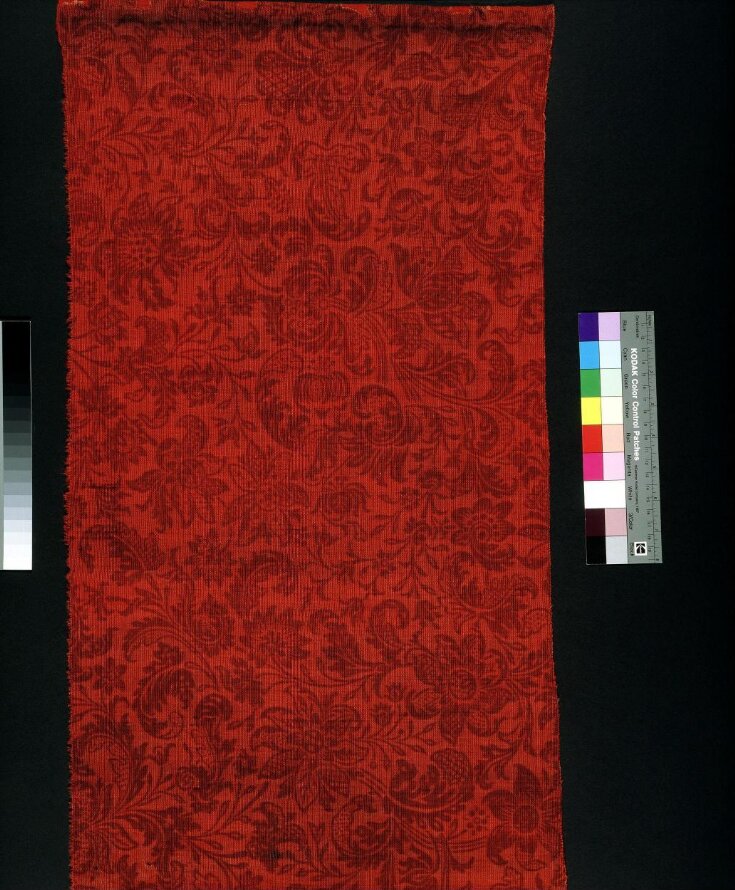
This fragment of furnishing fabric is a camlet, a plain, woven, ribbed worsted. It may be an example of a printed type of camlet described as 'paragon' in contemporary accounts. It was probably woven in Norwich, Norfolk, and may have been printed in London. Camlets were used for a wide variety of furnishings, including wall hangings, bed hangings, window curtains and upholstery.
Materials & Making
After weaving, worsted furnishings could be decorated in various ways. The process of 'watering' involved crushing the fabric so that the ribbed weave reflected the light unevenly, producing a wavy pattern. The fabric could also be given a self-coloured pattern by pressing it with hot plates against a wooden block carved with a design in imitation of woven damask. A third method involved printing in a contrasting colour, as in this case, and this fabric has also had its surface glazed.
Design & Designing
The stylised floral design here, with the fillings of flowers and leaves related to patterns in contemporary crewel-wool embroidered furnishings. It is now faded. It is stronger on the back, through to which the printing dye penetrated, and the bold original effect of the pattern is clearly evident.
This fragment of furnishing fabric is a camlet, a plain, woven, ribbed worsted. It may be an example of a printed type of camlet described as 'paragon' in contemporary accounts. It was probably woven in Norwich, Norfolk, and may have been printed in London. Camlets were used for a wide variety of furnishings, including wall hangings, bed hangings, window curtains and upholstery.
Materials & Making
After weaving, worsted furnishings could be decorated in various ways. The process of 'watering' involved crushing the fabric so that the ribbed weave reflected the light unevenly, producing a wavy pattern. The fabric could also be given a self-coloured pattern by pressing it with hot plates against a wooden block carved with a design in imitation of woven damask. A third method involved printing in a contrasting colour, as in this case, and this fabric has also had its surface glazed.
Design & Designing
The stylised floral design here, with the fillings of flowers and leaves related to patterns in contemporary crewel-wool embroidered furnishings. It is now faded. It is stronger on the back, through to which the printing dye penetrated, and the bold original effect of the pattern is clearly evident.
Object details
| Categories | |
| Object type | |
| Materials and techniques | Printed worsted wool |
| Brief description | Furnishing fabric fragment of printed worsted, probably woven in Norwich, possibly printed in London, 1680-1700 |
| Physical description | Furnishing fabric fragment of red worsted. It is plain woven, with a floral design printed in black which has now faded (it is stronger on the back, which it penetrated through to clearly). The fragment is a complete loom width, but does not have a complete repeat in the length. The surface has been glazed. The pattern is of stylised flowers, with the fillings of the flowers and leaves related to designs in contemporary crewel embroidered furnishings. This worsted was used as a wall covering. |
| Dimensions |
|
| Gallery label | British Galleries:
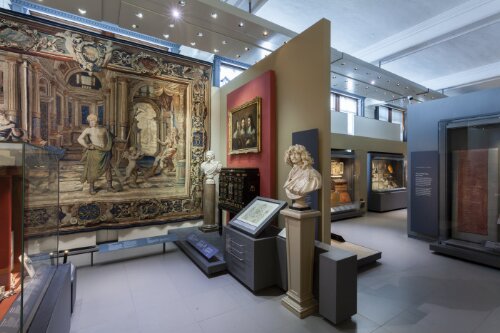
In this period new lightweight woollen fabrics were increasingly used for wall hangings, curtains and covers. This example is a camlet, a plain woven, ribbed, worsted wool. It has been printed with a pattern related to embroidery.(27/03/2003) |
| Credit line | Given by Viscountess Hampden |
| Object history | From Glynde Place, in Sussex. A letter from Viscount Hampden, October 1999, notes that when he moved in to the house in 1978 a room was hung with the red worsted concealed under1950s flock wallpaper (it was revealed when the flock wallpaper was stripped). The condition was so poor that the worsted was removed with the best bits salvaged to be newly hung in another smaller room. The only worsted remaining in its original place is on the door to the original room (the Red Room), very faded, held by copper studs. |
| Summary | Object Type This fragment of furnishing fabric is a camlet, a plain, woven, ribbed worsted. It may be an example of a printed type of camlet described as 'paragon' in contemporary accounts. It was probably woven in Norwich, Norfolk, and may have been printed in London. Camlets were used for a wide variety of furnishings, including wall hangings, bed hangings, window curtains and upholstery. Materials & Making After weaving, worsted furnishings could be decorated in various ways. The process of 'watering' involved crushing the fabric so that the ribbed weave reflected the light unevenly, producing a wavy pattern. The fabric could also be given a self-coloured pattern by pressing it with hot plates against a wooden block carved with a design in imitation of woven damask. A third method involved printing in a contrasting colour, as in this case, and this fabric has also had its surface glazed. Design & Designing The stylised floral design here, with the fillings of flowers and leaves related to patterns in contemporary crewel-wool embroidered furnishings. It is now faded. It is stronger on the back, through to which the printing dye penetrated, and the bold original effect of the pattern is clearly evident. |
| Collection | |
| Accession number | T.45-1981 |
About this object record
Explore the Collections contains over a million catalogue records, and over half a million images. It is a working database that includes information compiled over the life of the museum. Some of our records may contain offensive and discriminatory language, or reflect outdated ideas, practice and analysis. We are committed to addressing these issues, and to review and update our records accordingly.
You can write to us to suggest improvements to the record.
Suggest feedback
You can write to us to suggest improvements to the record.
Suggest feedback
| Record created | February 22, 1999 |
| Record URL |
Download as: JSONIIIF Manifest
