
The Neptune Jug
Ewer
1850 (made)
1850 (made)
| Artist/Maker | |
| Place of origin |
Object Type
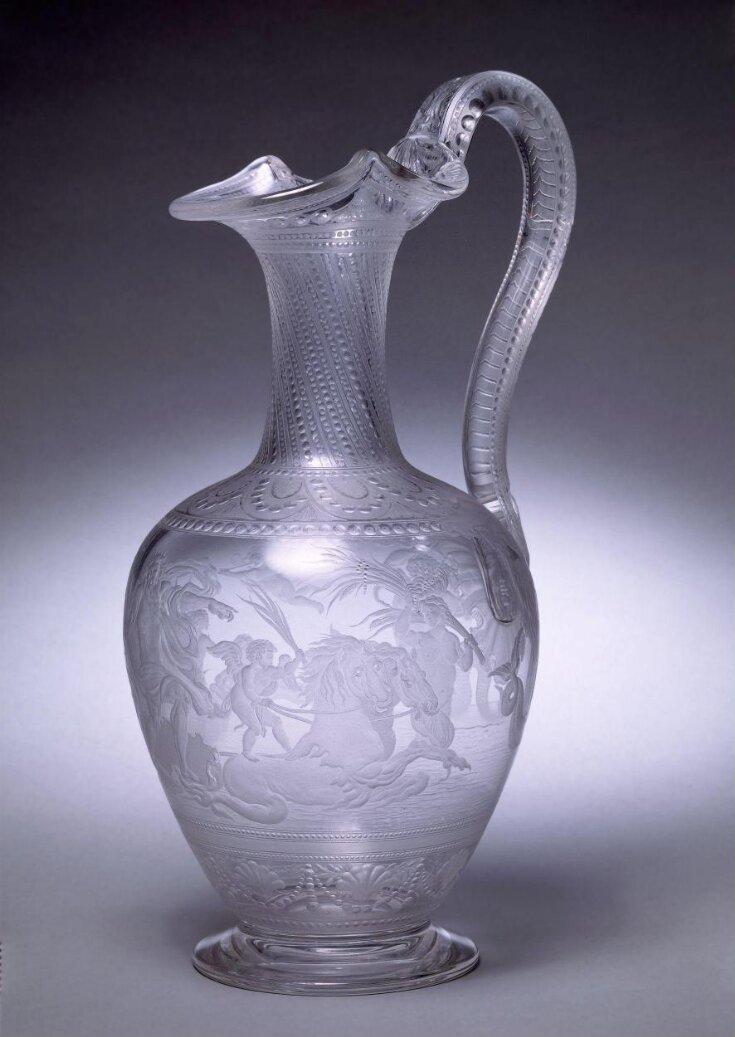
This water jug was much admired at the Great Exhibition for its elegant shape and engraved design. It draws inspiration from the Ancient Greek oinochoe shape, characterised by a high, curling handle and three-lipped mouth. It also echoes French Renaissance forms, themselves based on classical styles. The finely engraved scene of Neptune and accompanying figures serves to emphasise both the classical inspiration for the design and the intended use of the jug for water.
People
Joseph George Green, designer and manufacturer, of 19 St James's Street, Piccadilly, London, was awarded a prize medal at the Great Exhibition for his wheel-engraving, a technique that uses rotating discs (usually of copper) to cut a decorative design in glass. He is known to have ordered some of his glass vessels from W.H.B. Richardson of Stourbridge, though probably to his own design requirements.
Historical Associations
The glassware assembled at Green's stand in the Crystal Palace was praised for the 'general excellence of (the) forms' and 'large adherence to those principles which have been considered as best regulating the true use of this beautiful material'. The report of the Exhibition jury went on to give this judgement of Green's work: 'In his blown glass jugs, water-bottles and wine glasses, some of the purest forms derived from Greek utensils have been selected and adapted to the material and to present use. They have been decorated with ground ornamental forms in bands, and although the ornament is sometimes too redundant and dispersed, it is in the right direction.'
This water jug was much admired at the Great Exhibition for its elegant shape and engraved design. It draws inspiration from the Ancient Greek oinochoe shape, characterised by a high, curling handle and three-lipped mouth. It also echoes French Renaissance forms, themselves based on classical styles. The finely engraved scene of Neptune and accompanying figures serves to emphasise both the classical inspiration for the design and the intended use of the jug for water.
People
Joseph George Green, designer and manufacturer, of 19 St James's Street, Piccadilly, London, was awarded a prize medal at the Great Exhibition for his wheel-engraving, a technique that uses rotating discs (usually of copper) to cut a decorative design in glass. He is known to have ordered some of his glass vessels from W.H.B. Richardson of Stourbridge, though probably to his own design requirements.
Historical Associations
The glassware assembled at Green's stand in the Crystal Palace was praised for the 'general excellence of (the) forms' and 'large adherence to those principles which have been considered as best regulating the true use of this beautiful material'. The report of the Exhibition jury went on to give this judgement of Green's work: 'In his blown glass jugs, water-bottles and wine glasses, some of the purest forms derived from Greek utensils have been selected and adapted to the material and to present use. They have been decorated with ground ornamental forms in bands, and although the ornament is sometimes too redundant and dispersed, it is in the right direction.'
Object details
| Categories | |
| Object type | |
| Title | The Neptune Jug |
| Materials and techniques | Clear glass, wheel-engraved |
| Brief description | Ewer, England, made by an unknown manufacturer for J. G. Green, retailers, 1850-1851, 4453-1901 . |
| Physical description | Exhibited at the Great Exhibition of 1851. Transferred from the Museum of Practical Geology. |
| Dimensions |
|
| Style | |
| Gallery label |
|
| Object history | Manufactured for the retailers J.G. Green; the jug possibly made by W.H.B. Richardson, Stourbridge, West Midlands |
| Summary | Object Type This water jug was much admired at the Great Exhibition for its elegant shape and engraved design. It draws inspiration from the Ancient Greek oinochoe shape, characterised by a high, curling handle and three-lipped mouth. It also echoes French Renaissance forms, themselves based on classical styles. The finely engraved scene of Neptune and accompanying figures serves to emphasise both the classical inspiration for the design and the intended use of the jug for water. People Joseph George Green, designer and manufacturer, of 19 St James's Street, Piccadilly, London, was awarded a prize medal at the Great Exhibition for his wheel-engraving, a technique that uses rotating discs (usually of copper) to cut a decorative design in glass. He is known to have ordered some of his glass vessels from W.H.B. Richardson of Stourbridge, though probably to his own design requirements. Historical Associations The glassware assembled at Green's stand in the Crystal Palace was praised for the 'general excellence of (the) forms' and 'large adherence to those principles which have been considered as best regulating the true use of this beautiful material'. The report of the Exhibition jury went on to give this judgement of Green's work: 'In his blown glass jugs, water-bottles and wine glasses, some of the purest forms derived from Greek utensils have been selected and adapted to the material and to present use. They have been decorated with ground ornamental forms in bands, and although the ornament is sometimes too redundant and dispersed, it is in the right direction.' |
| Bibliographic references |
|
| Other number | |
| Collection | |
| Accession number | 4453-1901 |
About this object record
Explore the Collections contains over a million catalogue records, and over half a million images. It is a working database that includes information compiled over the life of the museum. Some of our records may contain offensive and discriminatory language, or reflect outdated ideas, practice and analysis. We are committed to addressing these issues, and to review and update our records accordingly.
You can write to us to suggest improvements to the record.
Suggest feedback
You can write to us to suggest improvements to the record.
Suggest feedback
| Record created | December 13, 1997 |
| Record URL |
Download as: JSONIIIF Manifest
