
Wine Glass
1849-1851 (made)
| Artist/Maker | |
| Place of origin |
Object Type
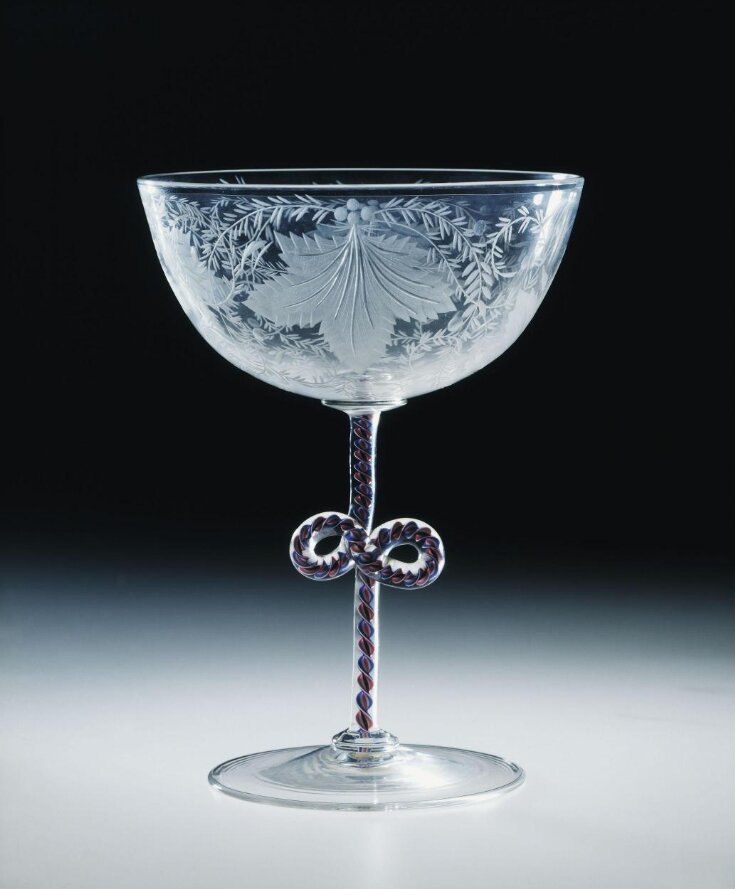
This glass, probably for champagne, is in the 'Anglo-Venetian' style popularised by Apsley Pellatt IV (1791-1863). The coloured twist stem and double loop were supposed to be reminiscent of 17th-century Venetian stems. John Tallis, in his History and Description of the Crystal Palace (1852), described the 'delicate twisted stems' of Bacchus' glasses as 'novel and chaste'.
People
George Bacchus & Sons was a Birmingham firm, previously known as Bacchus, Green and Green. They were one of the leading British glassmakers of the mid-19th century, keeping up with and sometimes creating stylistic and technical developments. They were known for, among other things, flashed glass and transfer-printing on glass, and by 1848 they had become the first English firm to produce Venetian-style millefiore glass (made from composite sections of coloured glass cane).
Historical Associations
Bacchus' collection of glassware at the Great Exhibition was described as 'not large but well designed and executed'. He exhibited examples of coloured and cased glass, cutting, engraving and enamelling. The range of vessels included a flower-stand, vases (including some cased in green and in ruby), a tazza (or shallow bowl), wine glasses, an enamelled sugar bowl and butter dish, cut glass decanters and engraved goblets.
This glass, probably for champagne, is in the 'Anglo-Venetian' style popularised by Apsley Pellatt IV (1791-1863). The coloured twist stem and double loop were supposed to be reminiscent of 17th-century Venetian stems. John Tallis, in his History and Description of the Crystal Palace (1852), described the 'delicate twisted stems' of Bacchus' glasses as 'novel and chaste'.
People
George Bacchus & Sons was a Birmingham firm, previously known as Bacchus, Green and Green. They were one of the leading British glassmakers of the mid-19th century, keeping up with and sometimes creating stylistic and technical developments. They were known for, among other things, flashed glass and transfer-printing on glass, and by 1848 they had become the first English firm to produce Venetian-style millefiore glass (made from composite sections of coloured glass cane).
Historical Associations
Bacchus' collection of glassware at the Great Exhibition was described as 'not large but well designed and executed'. He exhibited examples of coloured and cased glass, cutting, engraving and enamelling. The range of vessels included a flower-stand, vases (including some cased in green and in ruby), a tazza (or shallow bowl), wine glasses, an enamelled sugar bowl and butter dish, cut glass decanters and engraved goblets.
Object details
| Categories | |
| Object type | |
| Materials and techniques | Clear glass, engraved, with twisted, coloured threads in the stem |
| Brief description | Wine glass, engraved, with twisted, coloured threads in the stem, probably made by George Bacchus & Sons, England (Birmingham), 1849-1854 |
| Physical description | Wine Glass; clear glass, engraved & with twisted, coloured enamel threads in the stem. Wide, shallow bowl engraved with leaf & berry motif, resting on a figure of 8 twisted stem which has blue, red & white enamel threads in it. The whole resting on a circular foot. |
| Dimensions |
|
| Style | |
| Gallery label | British Galleries:
TWO WINE GLASSES engraved with Exhibition motifs Apsley Pellat, the famous firm of glass manufacturers, showed many drinking vessels in their display, as well as a huge chandelier. The twisted white threads in both stems imitate Venetian glass. Many glasses in this style were engraved, using motifs relevant for the occasion - including the globe (signifying the international theme) and the crown (signifying royal support).(27/03/2003) |
| Subjects depicted | |
| Summary | Object Type This glass, probably for champagne, is in the 'Anglo-Venetian' style popularised by Apsley Pellatt IV (1791-1863). The coloured twist stem and double loop were supposed to be reminiscent of 17th-century Venetian stems. John Tallis, in his History and Description of the Crystal Palace (1852), described the 'delicate twisted stems' of Bacchus' glasses as 'novel and chaste'. People George Bacchus & Sons was a Birmingham firm, previously known as Bacchus, Green and Green. They were one of the leading British glassmakers of the mid-19th century, keeping up with and sometimes creating stylistic and technical developments. They were known for, among other things, flashed glass and transfer-printing on glass, and by 1848 they had become the first English firm to produce Venetian-style millefiore glass (made from composite sections of coloured glass cane). Historical Associations Bacchus' collection of glassware at the Great Exhibition was described as 'not large but well designed and executed'. He exhibited examples of coloured and cased glass, cutting, engraving and enamelling. The range of vessels included a flower-stand, vases (including some cased in green and in ruby), a tazza (or shallow bowl), wine glasses, an enamelled sugar bowl and butter dish, cut glass decanters and engraved goblets. |
| Bibliographic references |
|
| Collection | |
| Accession number | 4449-1901 |
About this object record
Explore the Collections contains over a million catalogue records, and over half a million images. It is a working database that includes information compiled over the life of the museum. Some of our records may contain offensive and discriminatory language, or reflect outdated ideas, practice and analysis. We are committed to addressing these issues, and to review and update our records accordingly.
You can write to us to suggest improvements to the record.
Suggest feedback
You can write to us to suggest improvements to the record.
Suggest feedback
| Record created | December 13, 1997 |
| Record URL |
Download as: JSONIIIF Manifest
