
Petticoat
1700-1750 (made)
| Artist/Maker | |
| Place of origin |
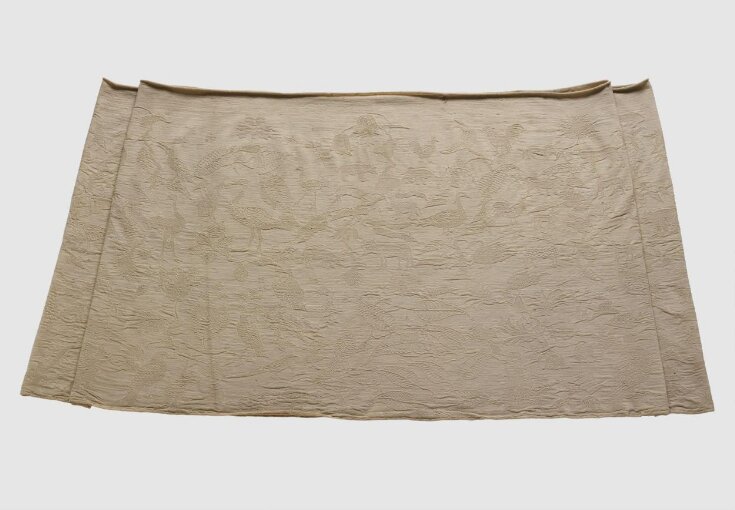
This petticoat is an extraordinary feat of knitting skill unparalleled in any other known collection. We do not know exactly how it was made. It seems too large to have been produced by hand or on a knitting frame. The only other similar garment was a petticoat knitted in a variety of abstract patterns within a diamond-shaped grid. Sold at Christies auction house in 1981, it too dated from the early 18th century and had both Dutch and English connections.
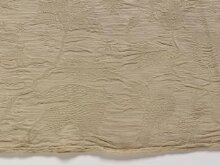
The cream-coloured petticoat is knitted in two-ply wool, with surface decoration of animals, birds and trees. Among the more exotic creatures are an elephant, a lion, an ostrich and a rhinoceros. The motifs are knitted in purl and plain on a background of stocking stitch.
The petticoat is knitted in the round with no seams and has a circumference of over 3 metres at the widest point. Despite the large surface area, the pattern does not repeat.
The cream-coloured petticoat is knitted in two-ply wool, with surface decoration of animals, birds and trees. Among the more exotic creatures are an elephant, a lion, an ostrich and a rhinoceros. The motifs are knitted in purl and plain on a background of stocking stitch.
The petticoat is knitted in the round with no seams and has a circumference of over 3 metres at the widest point. Despite the large surface area, the pattern does not repeat.
Delve deeper
Discover more about this object

Object details
| Categories | |
| Object type | |
| Materials and techniques | Hand knited in two ply wool |
| Brief description | Petticoat knit of ivory wool, possibly Dutch, 1700-1750 |
| Physical description | The petticoat is in the form of a very wide, short cylinder of continuous knitting with a non-repeating pattern of a wide variety of animals, birds, insects and plants and one human figure. Knit continuously without seams with all devices made of knit and purl stitches or combinations of the two, with eyelets for the eyes against a ground of stocking stitch. Approximately 2,650 stitches were cast on and worked in a gauge of twenty-two stitches per inch. |
| Dimensions |
|
| Production type | Unique |
| Gallery label | 3. UNFINISHED PETTICOAT
Hand-knitted two-ply worsted
Dutch, 17th to early 18th century.
The raised pattern of animals, birds and flowering trees is finely knitted in purl and combinations of plain and purl stitches against a stocking stitch ground. The petticoat was worked in the round (there are no seams) and has a circumference of 312 cms: the pattern does not repeat.
The attribution of this piece to Holland is traditional - the Dutch were known for the excellence of their knitting. A comparable petticoat knitted in cotton, with a lattice pattern incorporating the date 1722, appeared recently in a London sales room.
Bequeathed by Lt. Col. G.B.Croft Lyons FSA
T.177-1926(1985) |
| Credit line | Bequeathed by Lt. Col. G. B. Croft-Lyons FSA |
| Historical context | An extraordinary feat of knitting skill, this object is unparalleled in any other known collection. The exact means by which it was created are not clear, seeming too large for either hand or frame production. The only other similar garment sold at Christies in 1981, a petticoat knitted in a variety of abstract patterns within a diamond shaped grid. It too dated from the early 18th century and had both Dutch and English connections. |
| Subjects depicted | |
| Summary | This petticoat is an extraordinary feat of knitting skill unparalleled in any other known collection. We do not know exactly how it was made. It seems too large to have been produced by hand or on a knitting frame. The only other similar garment was a petticoat knitted in a variety of abstract patterns within a diamond-shaped grid. Sold at Christies auction house in 1981, it too dated from the early 18th century and had both Dutch and English connections. The cream-coloured petticoat is knitted in two-ply wool, with surface decoration of animals, birds and trees. Among the more exotic creatures are an elephant, a lion, an ostrich and a rhinoceros. The motifs are knitted in purl and plain on a background of stocking stitch. The petticoat is knitted in the round with no seams and has a circumference of over 3 metres at the widest point. Despite the large surface area, the pattern does not repeat. |
| Bibliographic references |
|
| Collection | |
| Accession number | T.177-1926 |
About this object record
Explore the Collections contains over a million catalogue records, and over half a million images. It is a working database that includes information compiled over the life of the museum. Some of our records may contain offensive and discriminatory language, or reflect outdated ideas, practice and analysis. We are committed to addressing these issues, and to review and update our records accordingly.
You can write to us to suggest improvements to the record.
Suggest feedback
You can write to us to suggest improvements to the record.
Suggest feedback
| Record created | February 16, 1999 |
| Record URL |
Download as: JSONIIIF Manifest
