Figure
ca. 1530 (made)
| Artist/Maker | |
| Place of origin |
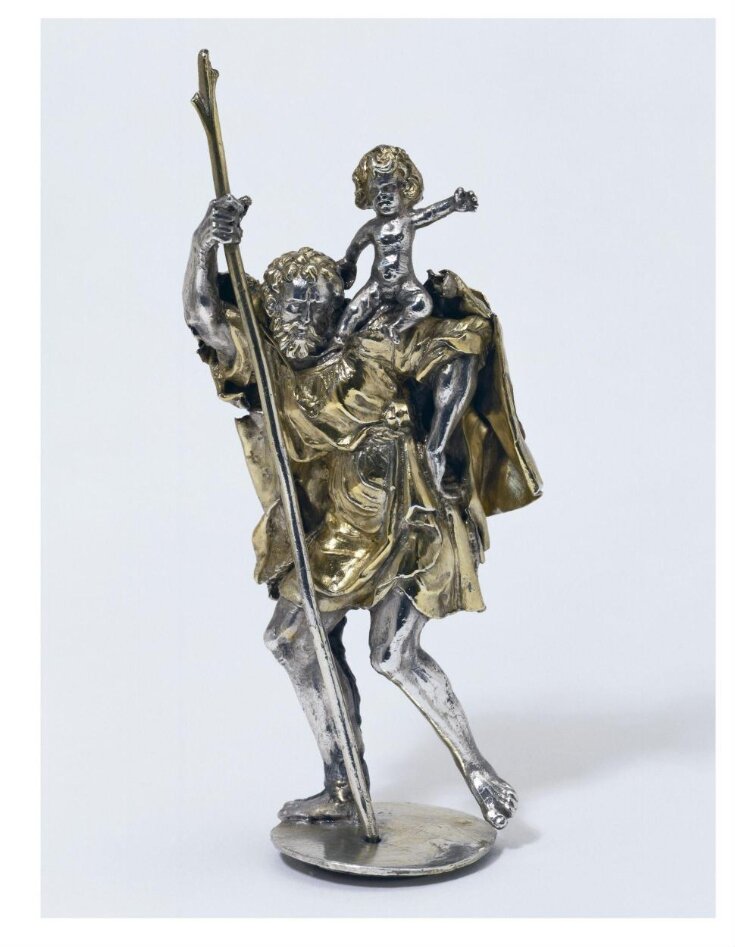
This small figure may be one of the few remaining fragments of the custodia of Cuenca Cathedral in Spain. The custodia was a very large silver object used for religious processions such as the annual Corpus Christi ('body of Christ') parade. The Cuenca custodia was broken up when the cathedral was looted by French soldiers in 1808.
According to legend, St Christopher showed his devotion to God by carrying travellers across a river. One day, he carried a child across the raging stream. Gradually the child grew heavier and heavier until Christopher felt as if he were carrying the whole weight of the world. When they arrived on the bank, the child revealed himself as Christ. In 1969, St Christopher was removed from the Catholic calendar of saints because of doubts as to his historical authenticity.
According to legend, St Christopher showed his devotion to God by carrying travellers across a river. One day, he carried a child across the raging stream. Gradually the child grew heavier and heavier until Christopher felt as if he were carrying the whole weight of the world. When they arrived on the bank, the child revealed himself as Christ. In 1969, St Christopher was removed from the Catholic calendar of saints because of doubts as to his historical authenticity.
Object details
| Categories | |
| Object type | |
| Materials and techniques | Silver, raised and parcel-gilt |
| Brief description | Figure of St Christopher, silver parcel-gilt. Spain, around 1530. |
| Physical description | Figure of St Christopher leaning upon a staff and carrying the infant Christ on his left shoulder. |
| Dimensions |
|
| Marks and inscriptions | (Unmarked) |
| Gallery label | St Christopher Carrying the Infant Christ
This small figure may be one of the few remaining fragments of the custodia of Cuenca Cathedral in Spain. The custodia was a very large silver object used for religious processions such as the annual Corpus Christi ('Body of Christ') parade. The Cuenca custodia was broken up when the cathedral was looted by French soldiers in 1808.
According to legend, St Christopher showed his devotion to God by carrying travellers across a river. One day, he carried a child across the raging stream. Gradually the child grew heavier and heavier until Christopher felt as if he were carrying the whole weight of the world. When they arrived on the bank, the child revealed himself as Christ. In 1969, St Christopher was removed from the Roman Catholic calendar of saints because of doubts as to his historical authenticity.
Spain, about 1530. Silver, partly gilded
Museum no. 178-1864(22/11/2005) |
| Object history | This figure is probably from the custodia of Cuenca Cathedral which was looted and broken up by French soldiers in 1808. Purchased at Saragossa by J.C. Robinson. |
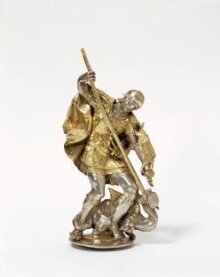
| Historical context | Saints and Symbols Like most religions, Christianity has a rich language of images and symbols. This iconography would have been clearly understood in the past but it may be less familiar to modern eyes. Though often decorative, the symbols used on religious metalwork also refer to the function and significance of the objects. The contemplation of religious motifs can draw believers into a deeper understanding of their faith. Complex theological themes can be represented in a visual form. A chalice, for example, might be adorned with the tools used in the Crucifixion (the ‘Instruments of the Passion’) to direct the viewer’s mind towards Christ’s sacrifice and his death on the cross. The use of images has caused controversy throughout Christian history. While supporters held that imagery glorified God and helped believers understand their faith better, critics attacked its use as superstition and idolatry. Saints Christians venerate saints as men and women who, through the holiness of their lives, became especially close to God. The saints include martyrs who suffered and died for their faith as well as great teachers and preachers. Their lives provide an example and inspiration for the faithful. Roman Catholics also believe that saints can intercede on their behalf with God. In Christian iconography, saints are usually depicted with a distinctive object or ‘attribute’ associated with their martyrdom or works. For example, St Bartholomew, who was skinned alive, holds a flaying knife, and St George is shown with a dragon. |
| Subject depicted | |
| Summary | This small figure may be one of the few remaining fragments of the custodia of Cuenca Cathedral in Spain. The custodia was a very large silver object used for religious processions such as the annual Corpus Christi ('body of Christ') parade. The Cuenca custodia was broken up when the cathedral was looted by French soldiers in 1808. According to legend, St Christopher showed his devotion to God by carrying travellers across a river. One day, he carried a child across the raging stream. Gradually the child grew heavier and heavier until Christopher felt as if he were carrying the whole weight of the world. When they arrived on the bank, the child revealed himself as Christ. In 1969, St Christopher was removed from the Catholic calendar of saints because of doubts as to his historical authenticity. |
| Associated object | 179-1864 (Set) |
| Bibliographic references |
|
| Collection | |
| Accession number | 178-1864 |
About this object record
Explore the Collections contains over a million catalogue records, and over half a million images. It is a working database that includes information compiled over the life of the museum. Some of our records may contain offensive and discriminatory language, or reflect outdated ideas, practice and analysis. We are committed to addressing these issues, and to review and update our records accordingly.
You can write to us to suggest improvements to the record.
Suggest feedback
You can write to us to suggest improvements to the record.
Suggest feedback
| Record created | August 31, 2004 |
| Record URL |
Download as: JSONIIIF Manifest
