Please complete the form to email this item.

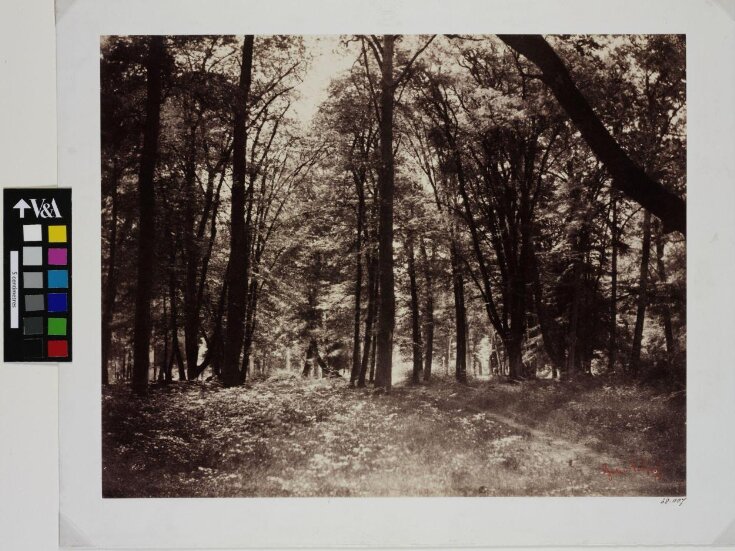
Photograph - Bas-Breau, Forest of Fontainebleau; In the Forst of Fontainebleau
  • Bas-Breau, Forest of Fontainebleau
    le gray, gustave, born 1820 - died 1884
  • Enlarge image

Bas-Breau, Forest of Fontainebleau; In the Forst of Fontainebleau

  • Object:

    Photograph

  • Place of origin:

    Fontainebleau, France (photographed)

  • Date:

    1851-1852 (photographed)

  • Artist/Maker:

    le gray, gustave, born 1820 - died 1884 (photographer)

  • Materials and Techniques:

    Gold-toned albumen print from waxed paper negative.

  • Credit Line:

    Chauncey Hare Townshend Bequest 1868

  • Museum number:

    68:007

  • Gallery location:

    Prints & Drawings Study Room, level H, case PX2, shelf 1

  • Download image

Gustave Le Gray trained as a painter in the 1840s but took up photography soon after. He followed the Barbizon School painters to the French forest of Fontainebleau, where he made enchanting photographic studies. Combining technical knowledge with artistic flair, Le Gray rapidly became one of the most renowned photographers of his day.

Physical description

Gold-toned albumen print photograph of the Forest of Fontainbleau. A clearing is depicted with wild flowers and a narrow path leading through the trees. The woodland becomes darker and thicker on either side of the path. A facsimilie signiature of the artist in red ink appears in the bottom right hand corner of the print.

Place of Origin

Fontainebleau, France (photographed)

Date

1851-1852 (photographed)

Artist/maker

le gray, gustave, born 1820 - died 1884 (photographer)

Materials and Techniques

Gold-toned albumen print from waxed paper negative.

Dimensions

Height: 300 mm, Width: 380 mm

Descriptive line

'Bas-Breau, Forest of Fontainbleau', photograph by Gustave Le Gray (1820-84). France, 1852.

Bibliographic References (Citation, Note/Abstract, NAL no)

Coe, Brian & Haworth-Booth, Mark. A Guide to Early Photographic Printing Processes. London: The Victoria and Albert Museum in association with Hurtwood Press, 1983.
The full text of the entry is as follows:

Gustave Le Gray French 1820-82
In the Forest of Fontainebleau 1851 (print after 1855)
Gold-toned albumen print from waxed paper negative
Facsimile signature in red ink
300 x 380 mm Mus. no. 68,007 Bequeathed by Chauncey Hare Townshend

The introduction of albumen paper by Blanquart-Evrard in 1850 coincided with the development of improved methods for making negatives with extra capacity for recording detail. Gustave Le Gray's own process, in which he waxed the calotype negative before sensitising, gave a negative with improved detail and better keeping properties. The new albumen paper, which held the image in a coating on the surface of the paper, could reproduce the finest details of the negatives. As in the salted paper process, the negative was printed-out in daylight. The presence of silver in the albumen coating other than that forming the image led to a yellowing of the highlights, or white, of the picture through reaction with sulphur compounds in the atmosphere and in the paper, and this yellowing is a useful method of distinguishing between a very lightly coated albumen paper and a salted paper print, where no yellowing will be present normally. In this print by Le Gray, the image has been partially gold-toned, changing the image colour from the normal reddish-brown to a purplish-brown.
Le Gray trained in the studios of Picot and Paul Delaroche and became the inspiration and teacher of many of the generation which took up the art of photography in the 1850s, including Nadar. He made an extensive series of views in the Forest of Fontainbleau using his new process in 1851. Early salted paper prints from these negatives are a sombre, bronze colour. In about 1855 he reprinted some of the negatives on albumen paper to achieve a warmer and more golden print colour as in the example. This print and others from the series were bought by one of the earliest identifiable collectors (aside from the Royal Family) of fine photographs, the Reverend Chauncey Hare Townshend. Townshend also acquired the work of Barbizon painter Henri Rousseau. In general terms the waxed paper process allowed crisper detail but longer exposure times than the calotype; here because of the longer exposure time the foliage outlines are softened by movement in the breeze. The atmospheric shimmer of the foliage in these prints appear to be unparalleled in other photographs of the time. Le Gray could be described as the major photographer of the Barbizon School.

Materials

Photograph

Techniques

Albumen; Toned; Waxed; Technique

Subjects depicted

Forest of Fontainebleau

Categories

Photographs

Collection code

PDP

Download image
Qr_O102519
Ajax-loader