
Drawing
18th century (made)
| Artist/Maker | |
| Place of origin |
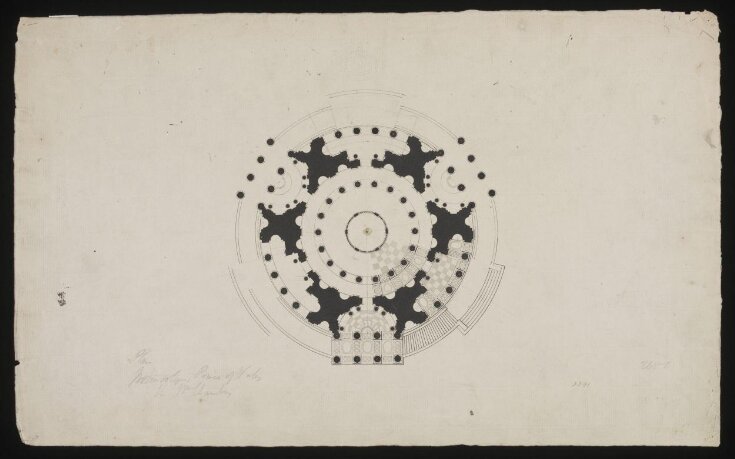
Plan of the mausoleum to the Prince of Wales, indicating treatment of floor tiles by leading architect and designer Sir William Chambers (1723-1796). The mausoleum was not built. There were three known projects for this building. All three drawings borrow both from the architecture of ancient Rome and that of Chambers’s architectural circle in Italy including M.A. Challe, L.J. le Lorrain, N.A. Jardin and especially Jean Laurent Legeay. The interior has elements of the Pantheon, and the exterior borrows from the tomb of Cecilia Metella. Chambers was employed at Kew by the Dowager Princess from 1757 to completely remodel the gardens. Between that date and 1763, Chambers erected twenty-five buildings and other features at Kew, in addition to designing unbuilt projects like the monument to the British poets.
Chambers was born in Sweden and died in London. He travelled widely, visiting China, and studied architecture at the Ecole des Arts, Paris, from 1749 and in Italy from 1750 to 1755. Many of his drawings from this period are contained in his important 'Franco-Italian' album, held in the V&A. Chambers moved to London in 1755 and published his influential Treatise on Civil Architecture in 1759. Chambers demonstrated the breadth of his style in buildings such as Gower (later Carrington) House and Melbourne House, London, in such country houses as Duddingston, Scotland, and in the garden architecture he designed for Wilton House, Wiltshire, and at Kew Gardens. He became head of government building in 1782, and in this capacity built Somerset House, London.
Chambers was born in Sweden and died in London. He travelled widely, visiting China, and studied architecture at the Ecole des Arts, Paris, from 1749 and in Italy from 1750 to 1755. Many of his drawings from this period are contained in his important 'Franco-Italian' album, held in the V&A. Chambers moved to London in 1755 and published his influential Treatise on Civil Architecture in 1759. Chambers demonstrated the breadth of his style in buildings such as Gower (later Carrington) House and Melbourne House, London, in such country houses as Duddingston, Scotland, and in the garden architecture he designed for Wilton House, Wiltshire, and at Kew Gardens. He became head of government building in 1782, and in this capacity built Somerset House, London.
Object details
| Categories | |
| Object type | |
| Materials and techniques | Pen and ink, pencil, ink wash and watercolour |
| Brief description | Plan of the mausoleum to the Prince of Wales, indicating treatment of floor tiles, 18th Century, Sir William Chambers (1723-1796). |
| Physical description | Plan of the mausoleum to the Prince of Wales, indicating treatment of floor tiles. |
| Dimensions |
|
| Production type | Design |
| Marks and inscriptions | 'Plan Mausoleum Prince of Wales Sir WM Chambers.' (Written in pencil in C.J. Richardson's hand) |
| Object history | Bought from C.J. Richardson, 1864 |
| Historical context | The mausoleum was not built. There were three known projects for this building. All three drawings borrow both from the architecture of ancient Rome and that of Chambers's architectural circle in Italy including M.A. Challe, L.J. le Lorrain, N.A. Jardin and especially Jean Laurent Legeay. The interior has elements of the Pantheon, and the exterior borrows from the tomb of Cecilia Metella. Chambers was employed at Kew by the Dowager Princess from 1757 to completely remodel the gardens. Between that date and 1763, Chambers erected twenty-five buildings and other features at Kew, in addition to designing unbuilt projects like the monument to the British poets. |
| Subjects depicted | |
| Summary | Plan of the mausoleum to the Prince of Wales, indicating treatment of floor tiles by leading architect and designer Sir William Chambers (1723-1796). The mausoleum was not built. There were three known projects for this building. All three drawings borrow both from the architecture of ancient Rome and that of Chambers’s architectural circle in Italy including M.A. Challe, L.J. le Lorrain, N.A. Jardin and especially Jean Laurent Legeay. The interior has elements of the Pantheon, and the exterior borrows from the tomb of Cecilia Metella. Chambers was employed at Kew by the Dowager Princess from 1757 to completely remodel the gardens. Between that date and 1763, Chambers erected twenty-five buildings and other features at Kew, in addition to designing unbuilt projects like the monument to the British poets. Chambers was born in Sweden and died in London. He travelled widely, visiting China, and studied architecture at the Ecole des Arts, Paris, from 1749 and in Italy from 1750 to 1755. Many of his drawings from this period are contained in his important 'Franco-Italian' album, held in the V&A. Chambers moved to London in 1755 and published his influential Treatise on Civil Architecture in 1759. Chambers demonstrated the breadth of his style in buildings such as Gower (later Carrington) House and Melbourne House, London, in such country houses as Duddingston, Scotland, and in the garden architecture he designed for Wilton House, Wiltshire, and at Kew Gardens. He became head of government building in 1782, and in this capacity built Somerset House, London. |
| Bibliographic references |
|
| Collection | |
| Accession number | 3341 |
About this object record
Explore the Collections contains over a million catalogue records, and over half a million images. It is a working database that includes information compiled over the life of the museum. Some of our records may contain offensive and discriminatory language, or reflect outdated ideas, practice and analysis. We are committed to addressing these issues, and to review and update our records accordingly.
You can write to us to suggest improvements to the record.
Suggest feedback
You can write to us to suggest improvements to the record.
Suggest feedback
| Record created | June 30, 2009 |
| Record URL |
Download as: JSONIIIF Manifest
