Waistcoat
1630-1640 (made)
| Artist/Maker | |
| Place of origin |
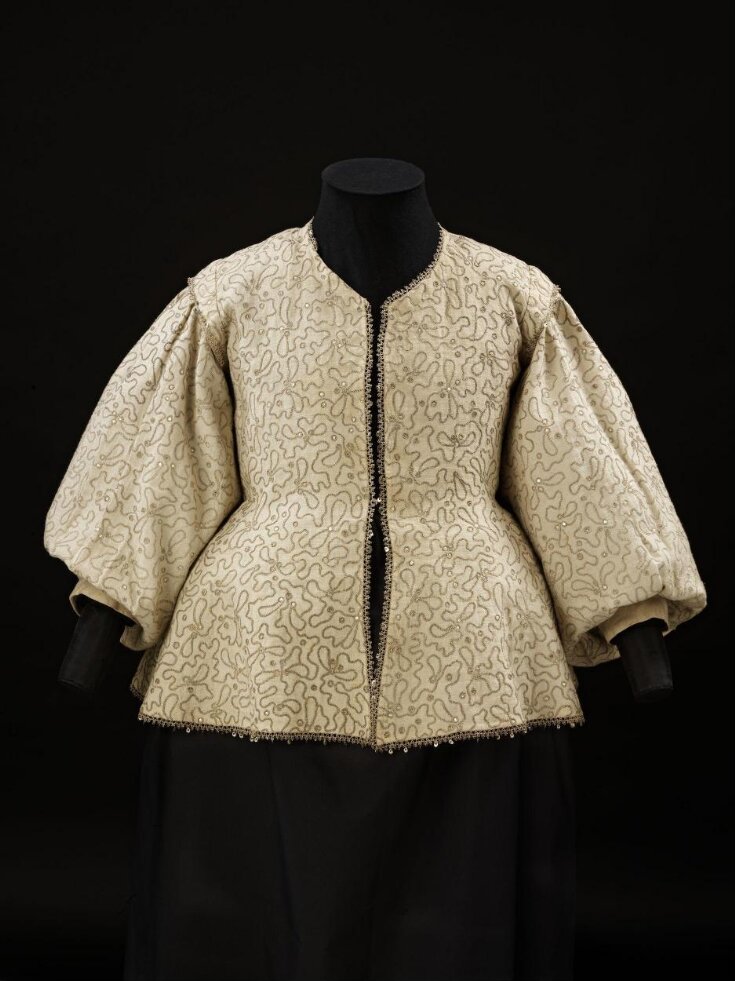
The high waist and full sleeves set into the back of this waistcoat are characteristic of women’s dress of the 1630s. The style of embroidery is quite unusual: a striking design of meandering lines rather than the naturalistic floral patterns typically seen on earler embellished waistcoats. This abstract design is probably imitating the ‘wave and flower’ patterns of Italian woven silks of the 1620s and 1630s. The sycamore motif used here may be symbolic of sorrowful love. Also unusual is the waistcoat’s modest fabric; a mix of cotton and linen, called fustian, which was often used for linings. The embroidery, however, is carried out in silver thread and embellished with silver bobbin lace and silver spangles.
Object details
| Categories | |
| Object type | |
| Materials and techniques | Linen, cotton, silver; hand-woven, hand-embroidered, hand-sewn |
| Brief description | Woman's waistcoat of fustian embroidered with silver thread, English, 1630-1640 |
| Physical description | Woman's waistcoat of fustian (linen warp, cotton weft), unlined. It has a high waistline, very full sleeves set into the back and narrow shoulder wings. The waistcoat opens downt the front and the skirts are inset with gores. It is worked all over in chain stitch with silver filé in a design of meandering lines and a motif resembling a sycamore seed case, embellished with spangles. The neck, front and lower hem are edged with a simple bobbin lace of silver filé and spangles. |
| Dimensions |
|
| Credit line | Purchased with Art Fund support |
| Object history | The waistcoat is from the Chaffyn Grove family. In 1686, John Grove married Mary Chaffyn, inheriting Zeals house from her and their descendants took the name Chaffyn Grove. The waistcoat was once said to have been given to Mary Grove by Charles II, but is clearly of an earlier date. In the 19th century, a female successory married into the Troyte Bullock family. Historical significance: This is a fine example of informal women's dress in the 1630s. While embroidered linen waistcoats of the period 1600-1630 survive in museum collections and appear in portraiture, this is an unusual example. The rather coarse fustian, normally used for linings, has been richly embellished with silver thread, spangles and lace. The rather abstract design of needlework shows the progression from the naturalistic style of a decade earlier. |
| Summary | The high waist and full sleeves set into the back of this waistcoat are characteristic of women’s dress of the 1630s. The style of embroidery is quite unusual: a striking design of meandering lines rather than the naturalistic floral patterns typically seen on earler embellished waistcoats. This abstract design is probably imitating the ‘wave and flower’ patterns of Italian woven silks of the 1620s and 1630s. The sycamore motif used here may be symbolic of sorrowful love. Also unusual is the waistcoat’s modest fabric; a mix of cotton and linen, called fustian, which was often used for linings. The embroidery, however, is carried out in silver thread and embellished with silver bobbin lace and silver spangles. |
| Bibliographic references |
|
| Collection | |
| Accession number | T.70-2004 |
About this object record
Explore the Collections contains over a million catalogue records, and over half a million images. It is a working database that includes information compiled over the life of the museum. Some of our records may contain offensive and discriminatory language, or reflect outdated ideas, practice and analysis. We are committed to addressing these issues, and to review and update our records accordingly.
You can write to us to suggest improvements to the record.
Suggest feedback
You can write to us to suggest improvements to the record.
Suggest feedback
| Record created | July 19, 2004 |
| Record URL |
Download as: JSONIIIF Manifest
